From Founder-Dependent Chaos to Scalable Revenue Engine
7.8× Revenue Growth in 10 Months
The Context
After three years of building his healthcare coaching business, the founder had proven something valuable: his methodology worked. French therapists — osteopaths, psychologists, naturopaths — were filling their patient calendars using his digital marketing frameworks.
But success had created its own prison.
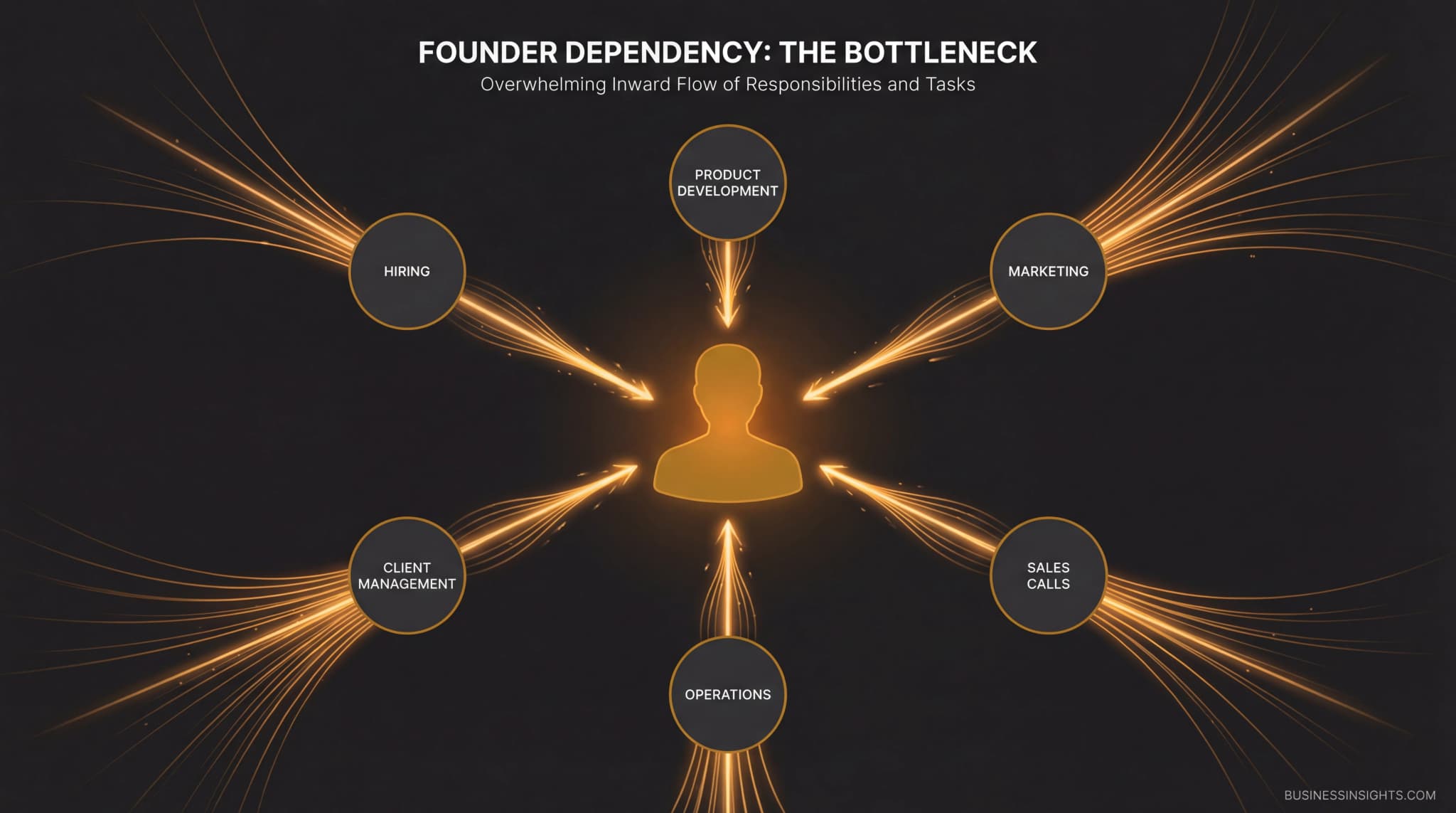
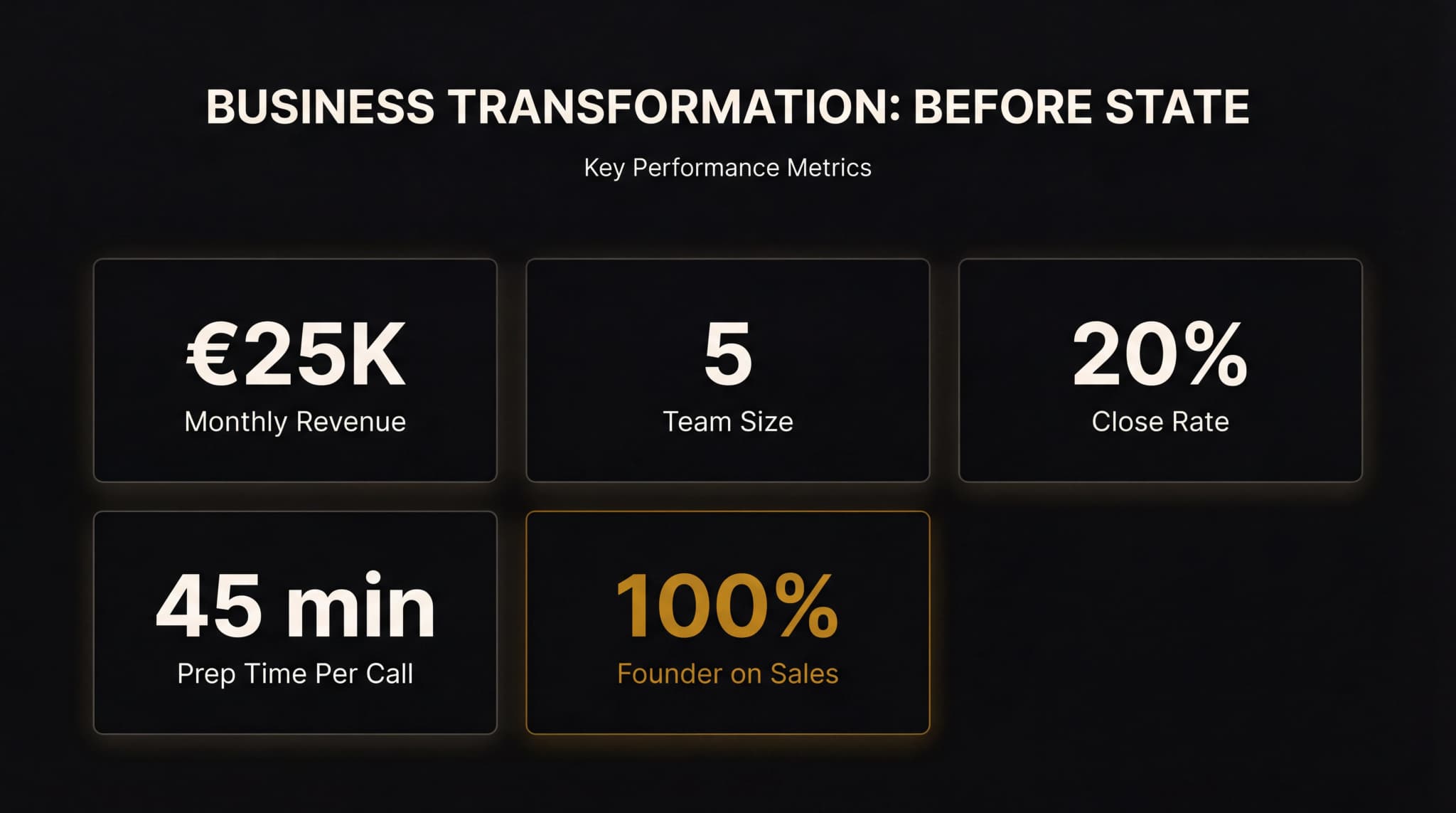
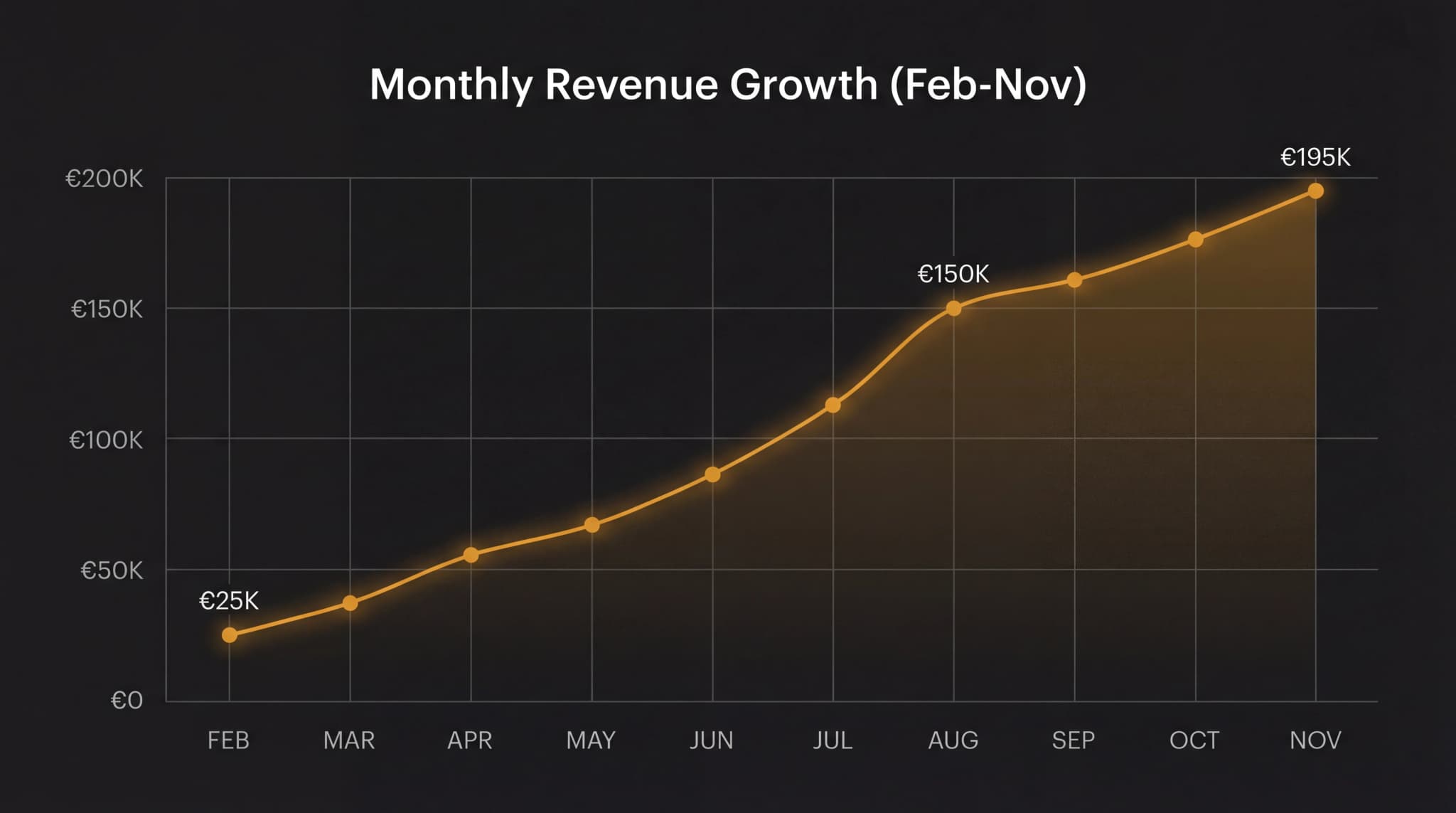
With €25,000 in monthly revenue and a five-person team, the founder was personally handling every sales call, managing every client relationship, and attempting to scale advertising — all while developing new products and creating marketing content. He was working 70-80 hour weeks. Burnout wasn't approaching; it had arrived.
The business had traction. What it lacked was architecture.
A mutual contact made the introduction. The brief was deceptively simple: "Help us scale sales." The reality would prove far more comprehensive.
The Challenge
Our initial diagnostic revealed interconnected problems across sales, operations, and organizational structure. The surface symptom was "sales bottleneck." The root cause was systematic founder dependency.
Sales Architecture: Non-Existent
The entire revenue engine depended on one person:
- Founder handled 100% of sales calls personally — 8-10 calls daily
- No qualification framework — time wasted on unqualified prospects
- 45 minutes spent preparing custom presentations for each call
- Single-call close or nothing — no structured sales process
- No follow-up sequences or nurture systems
- 20% close rate (respectable, but unstable without systems)
Operational Infrastructure: Absent
Beyond basic Notion documentation, there was nothing:
- No CRM system
- No call scheduling software
- No automation workflows
- No standardized processes for any function
- No team structure or role definitions
- Knowledge lived entirely in the founder's head
Team Structure: Founder as Bottleneck
The five-person team existed to support clients, not to scale the business:
- No dedicated sales team
- No operations infrastructure
- Founder simultaneously doing sales + product + marketing + operations
- Every decision required founder involvement
- Impossible to take a day off without consequences
The Real Problem
The company had proven product-market fit. Their 20% close rate was respectable. Their 80% show-up rate indicated genuine market demand. What they lacked wasn't strategy or product quality — it was the operational architecture to scale beyond what one person could personally manage.
This wasn't a sales problem. It was a systems problem manifesting as a sales bottleneck.
The Architecture
The engagement unfolded across two phases over ten months: Sales System Build-Out (February–August) followed by Full Operations Scaling (August–November). Each phase built upon the previous, creating compounding infrastructure.
Phase 1: Sales System Build-Out (Months 1-6)
Foundation: Technology Stack
Before any process could work, the infrastructure had to exist:
Evaluated options, implemented initial CRM, discovered integration failures. Pivoted to Pipedrive — full integration with call scheduling and automation. Built automated stage progression, activity tracking, and reporting dashboards.
Implemented professional scheduling software. Configured automatic calendar management. Built confirmation and reminder sequences (24h, 12h, 3h before calls). Integrated seamlessly with CRM for complete data visibility.
Built workflows for email and SMS sequences. Created automated lead routing based on qualification criteria. Implemented systematic follow-up sequences (minimum 4 touches over 3 days).
Architecture: Complete Sales Process Design
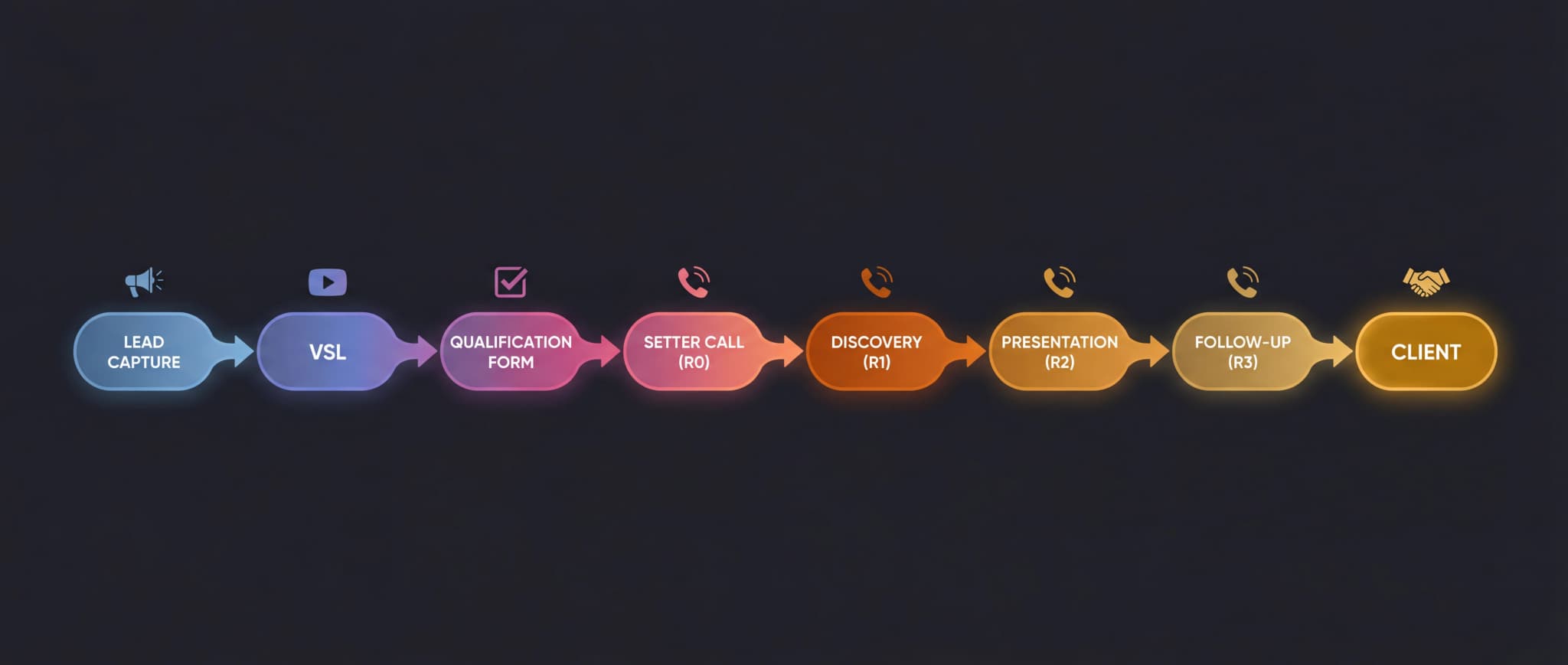
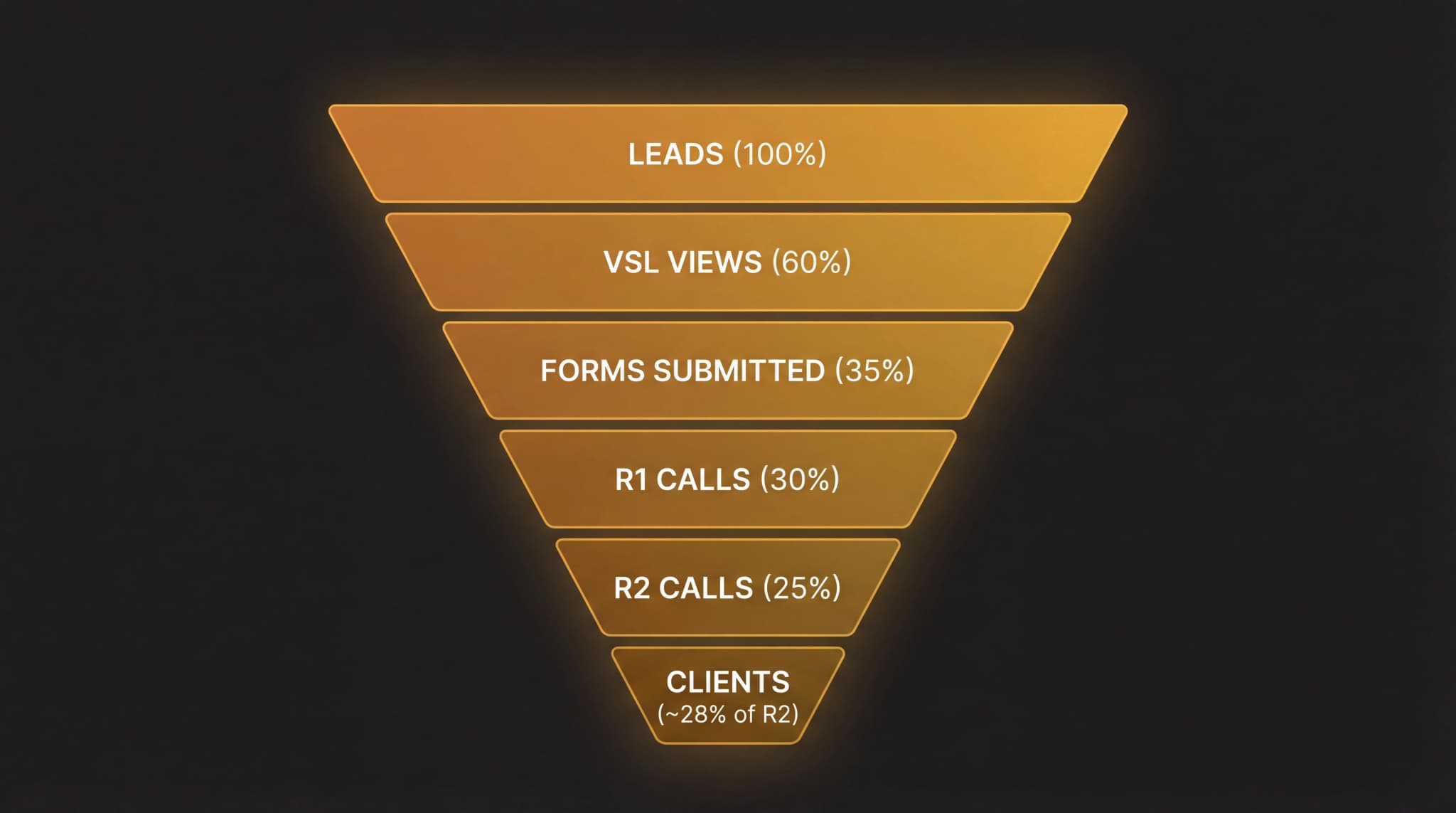
Designed and implemented a multi-stage qualification process:
Key Architectural Decisions:
- 1. Setter/Closer Specialization: Setters handle qualification, calendar management, and preparation. Closers focus exclusively on qualified prospects ready to buy. Specialization dramatically improved conversion economics.
- 2. Two-Call Sales Structure: R1 (Discovery): 45 minutes — pain identification, solution introduction. R2 (Presentation): Price presentation, objection handling, closing. Reduced pressure, improved qualification, increased close rates.
- 3. BTAN + Qualification Framework:
- Budget: Can they afford the investment?
- Timing: When do they need to solve this?
- Authority: Are they the decision-maker?
- Need: Do they have the problem we solve?
- +Maturity: Digital literacy level (0-3 scale)
- +Assets: Existing site, reviews, Google Business Profile
- +Ad Capacity: Minimum €300/month advertising budget
Team: Building the Revenue Engine
Built the sales team in strategic waves:
| Wave | Timing | Additions |
|---|---|---|
| Wave 1 | Month 2 | 2 setters, 2 closers |
| Wave 2 | Month 3-4 | 2 setters, 1 closer |
| Wave 3 | Month 5-6 | 2 closers, 1 Head of Sales |
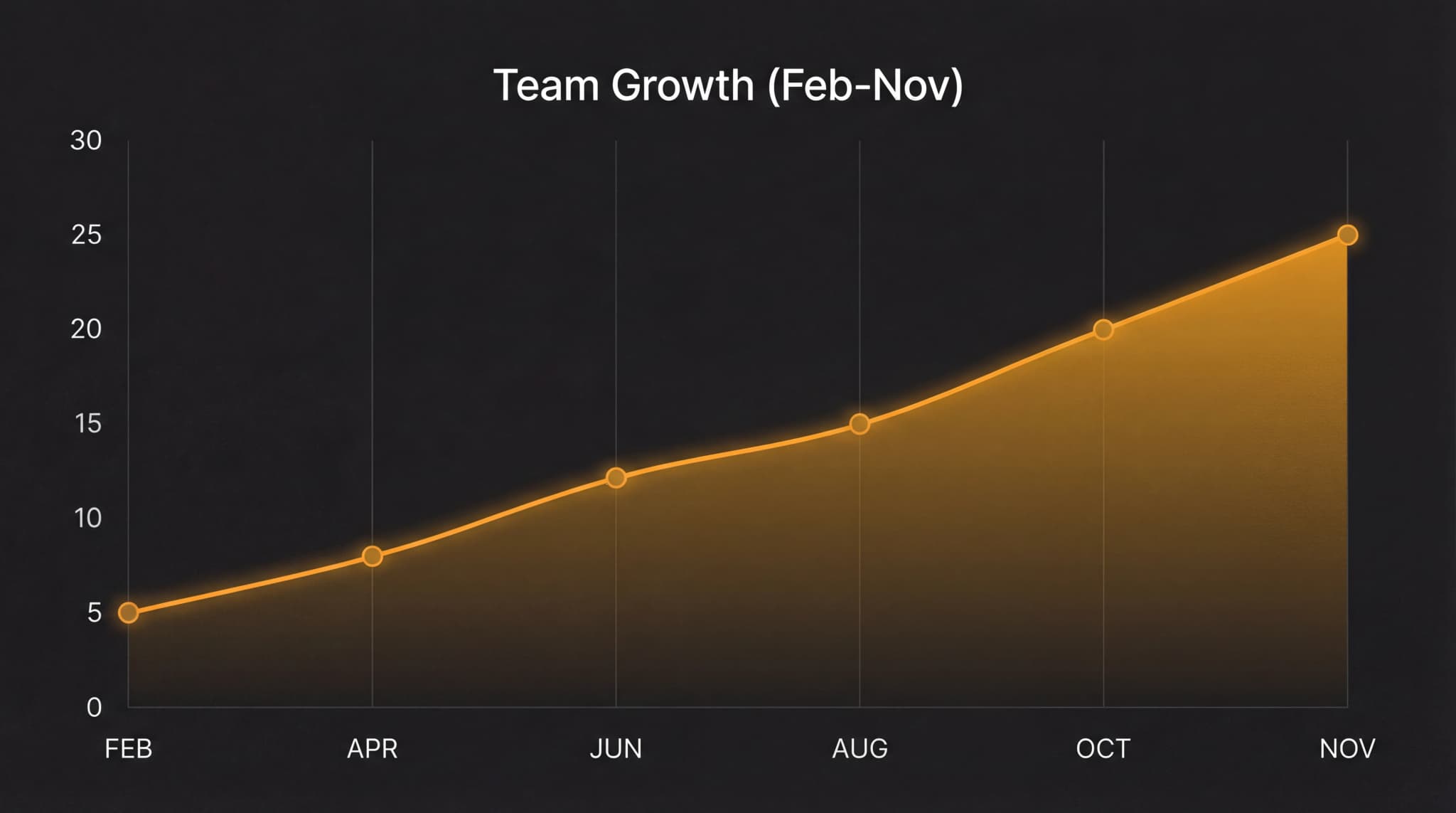
Total transformation: 1 person (founder) → 8-person dedicated sales team
The Breakthrough: Presentation Systematization
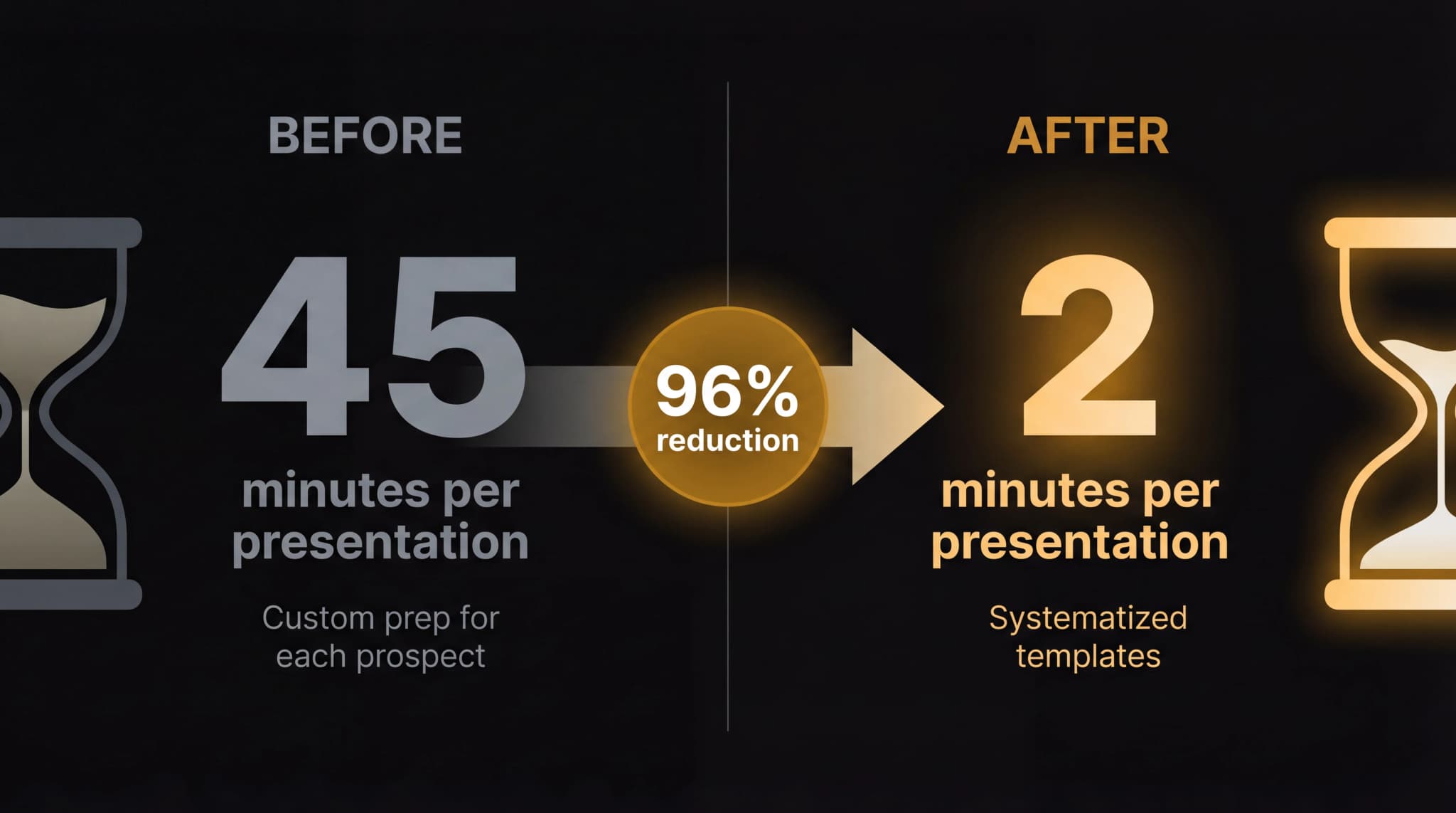
By month four, a critical bottleneck emerged. Closers were spending 45 minutes creating customized presentations for each prospect. With 18+ distinct customer segments (therapist profession × market size), this was unsustainable.
Solution: Systematic Standardization
- Segment-Specific Templates: Created presentation frameworks for each profession (osteopath, psychologist, naturopath, etc.). Built geographic market adaptations. Included profession-specific pain points, case studies, ROI calculations.
- Dynamic Generation System: Developed AI-assisted prompts using R1 call transcripts. Auto-generated personalized R2 presentations in minutes. Maintained personalization while achieving standardization.
- Master Sales Playbook: 63+ pages documenting every step of the process. Scripts for every common scenario. Objection handling frameworks. Stage-by-stage KPI definitions.
Result: Presentation prep dropped from 45 minutes to 2 minutes — a 96% time reduction — while conversion rates actually improved.
Phase 2: Full Operations Scaling (Months 7-10)
With the sales engine running, focus shifted to organizational architecture.
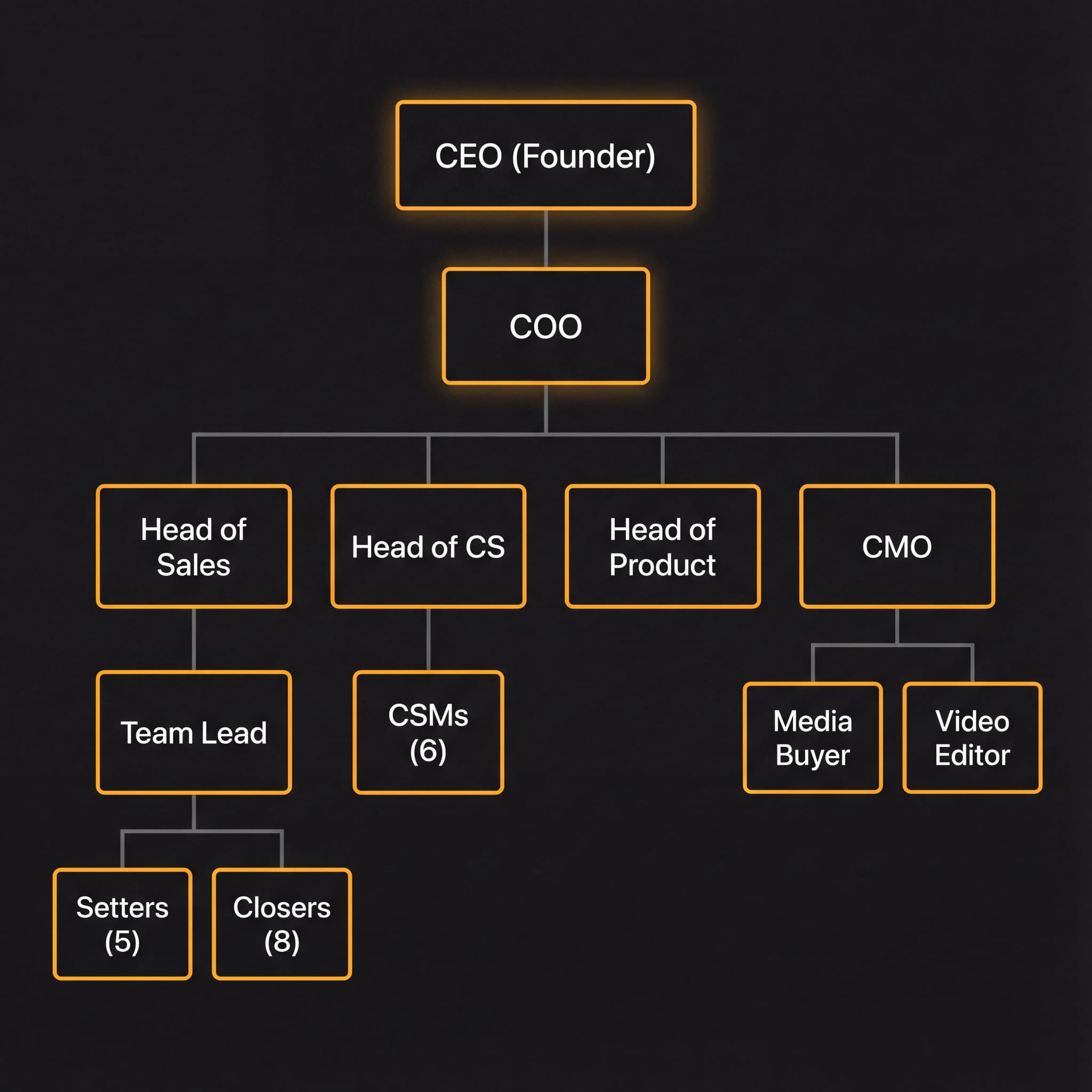
Organizational Structure
Created clear functional divisions with defined reporting lines. This eliminated the "everyone goes directly to the founder" bottleneck that had paralyzed decision-making.
Customer Success Operations
With 30-40 new clients onboarding monthly, systematic CSM operations became critical:
- Hour 0: Automated welcome with platform access
- Hour 24: First coaching call scheduled
- Day 2: Technical setup initiated
- Day 7: Strategy call, 90-day roadmap delivered
- Day 14: First optimization review
- Weekly check-ins for first 30 days
- Bi-weekly thereafter
- Monthly results reviews with NPS scoring
- Quarterly business reviews for premium clients
Documentation Infrastructure
Created comprehensive operational documentation:
| Product Guide | 22 pages | All offerings, pricing, qualification criteria |
| Sales Playbook | 63 pages | Complete sales process, scripts, objection handling |
| Operations Manual | 40+ pages | Team structure, processes, tool guides |
| Onboarding Playbooks | 25+ pages | Role-specific training for each position |
Total: 150+ pages of living documentation — enabling any new hire to become productive within 7-14 days.
The Execution
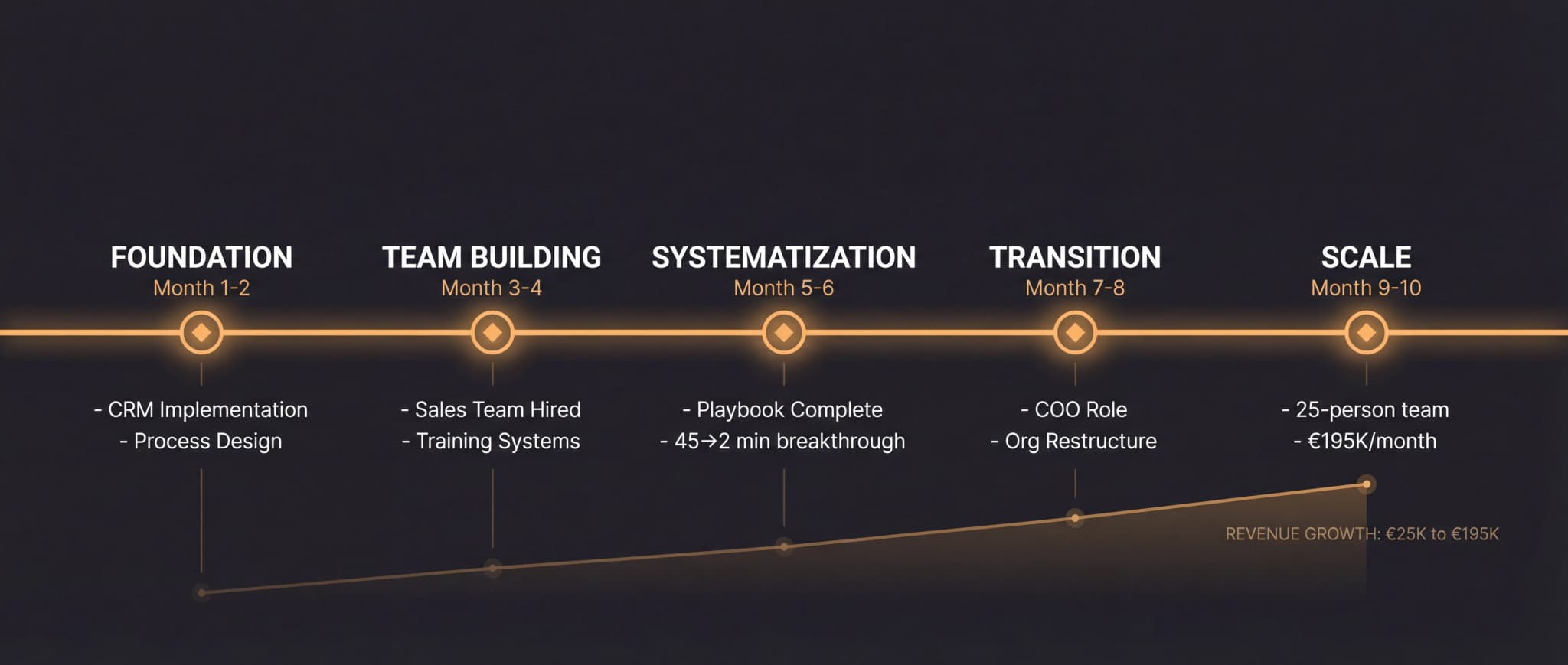
Timeline
| Month | Phase | Key Milestones |
|---|---|---|
| 1-2 | Foundation | CRM implementation, sales process design, first hires |
| 3-4 | Team Building | Sales team waves 1-2, training systems, initial playbooks |
| 5-6 | Systematization | Presentation automation, 63-page playbook, Head of Sales hired |
| 7-8 | Transition | COO role assumed, organizational restructure initiated |
| 9-10 | Scaling | Full documentation complete, 25-person team operational |
Implementation Approach
The engagement was hands-on throughout:
- Directly built systems rather than just advising
- Participated in hiring interviews, wrote job descriptions, trained team members
- Created all documentation personally
- Made calls alongside the team to understand real dynamics
- Iterated based on data, not assumptions
Philosophy applied: Launch MVP systems, gather data, improve based on reality. The first CRM didn't work — switched to Pipedrive without ego. The first scripts needed refinement — iterated weekly based on call recordings.
The Transformation
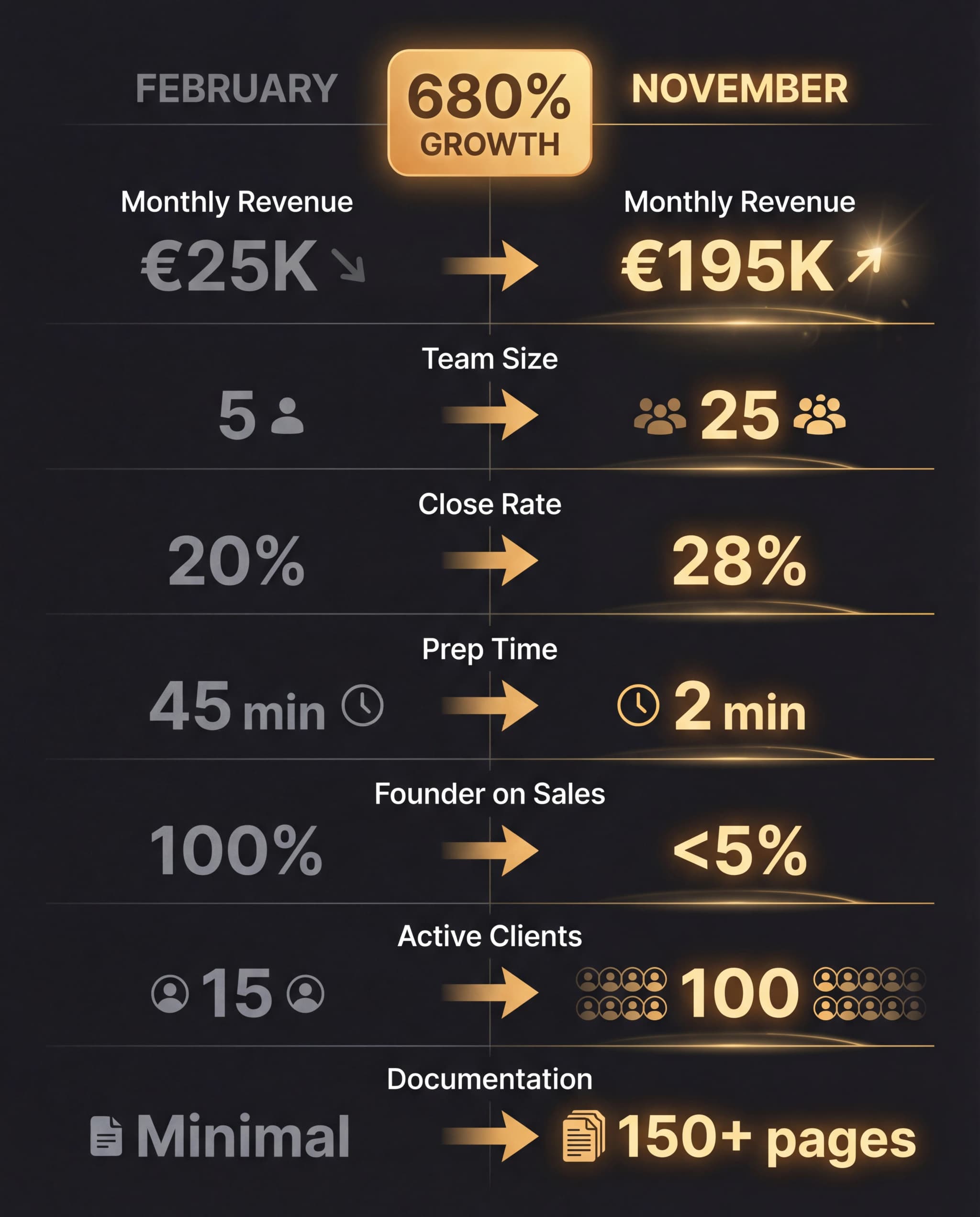
The Numbers
| Metric | February (Start) | November (End) | Change |
|---|---|---|---|
| Monthly Revenue | €25,000 | €195,000 | +680% |
| Team Size | 5 people | 20-25 people | +400% |
| Sales Conversion Rate | 20% | 25-30% | +25-50% |
| Presentation Prep Time | 45 minutes | 2 minutes | -96% |
| Founder Time on Sales | 100% | <5% | -95% |
| Active Clients | ~15 | 80-120 | +600% |
| Monthly New Clients | 5-7 | 30-40 | +500% |
Beyond the Numbers
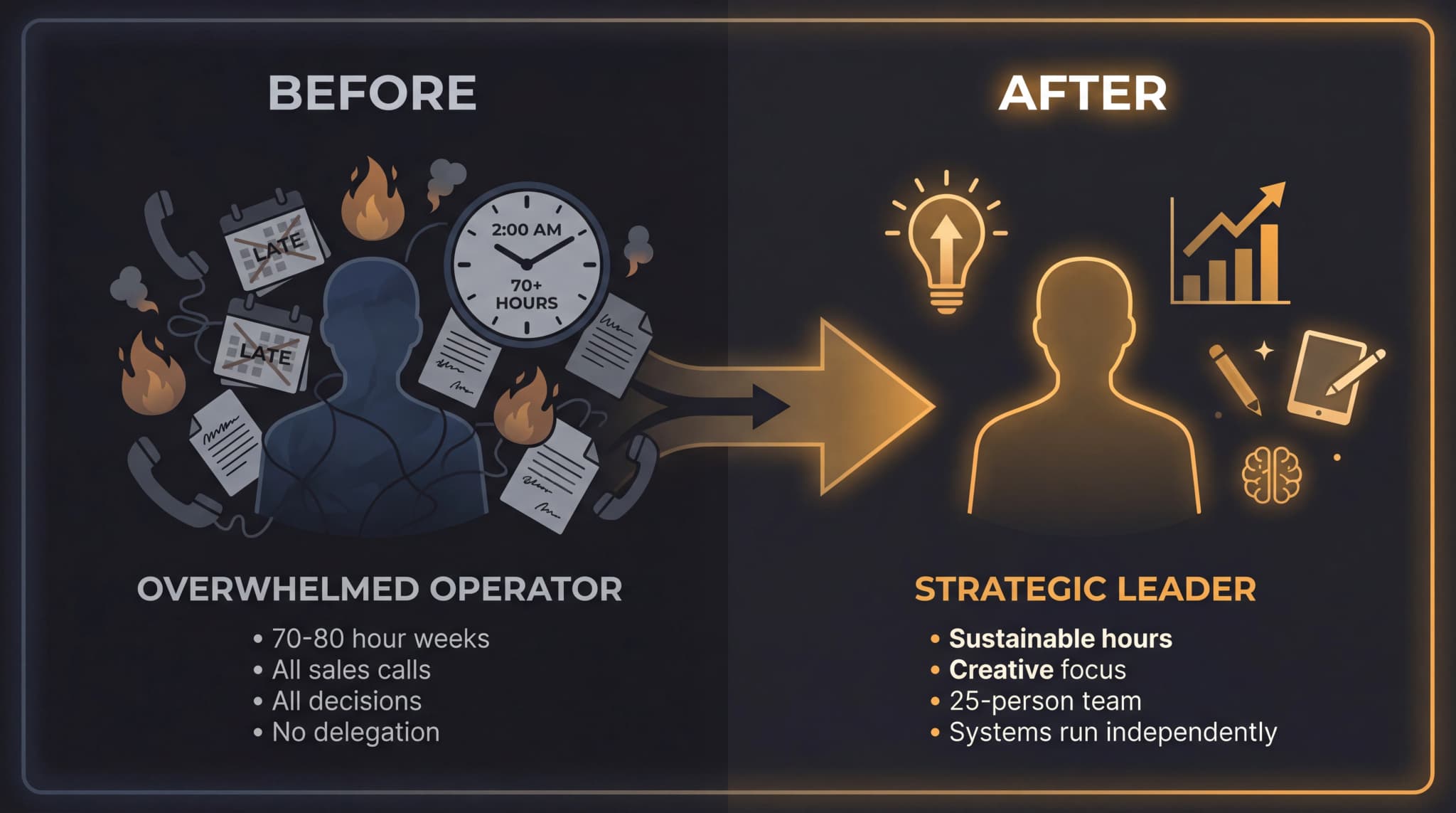
Before: Overwhelmed Operator
- Taking 100% of sales calls personally (8-10/day)
- Managing all client relationships
- Creating all marketing content
- Making all decisions, fighting all fires
- Working 70-80 hour weeks
- No ability to delegate
- Burnout imminent
After: Strategic Leader
- Taking <5% of sales calls (strategic deals only)
- Focusing on content creation and creative vision
- Developing new products and partnerships
- Working sustainable hours with clear boundaries
- Leading a 25-person organization with functional departments
- Confident in systems running independently
What This Transformation Enabled
The business shifted from "founder-dependent practice" to "systematized company":
- Predictability: Revenue became forecastable based on pipeline metrics
- Scalability: Clear capacity planning and hiring roadmaps
- Sustainability: Operations continued smoothly during founder absences
- Optionality: Business became valuable beyond founder's personal involvement
What This Case Teaches
1. Founder Dependency is a Systems Problem
The founder wasn't incompetent — he was overwhelmed because he'd built a business without the systems to scale it. The solution wasn't "work harder" or "hire more people." It was building architecture that could function independently of any single person.
2. Standardization Scales, Customization Doesn't
The 45-minute to 2-minute presentation transformation was the unlock. Most founders resist standardization ("but our clients are different!"). The insight: standardize the framework, personalize the details. Templates for each segment achieved both consistency and relevance.
3. Qualification is More Valuable Than Closing
Better setters dramatically improved closer performance. Time spent with unqualified prospects is the killer of sales team efficiency. The BTAN + qualification framework paid for itself within weeks by focusing closer time only on prospects ready to buy.
4. Documentation is a Forcing Function for Clarity
Writing the 63-page sales playbook revealed gaps in our own thinking. If you can't document it clearly, you don't understand it well enough. Living documentation — updated based on results — beats "set it and forget it."
5. Team Structure Matters More Than Talent
Mediocre people in a great system outperform great people in no system. Clear roles, KPIs, and escalation paths eliminate most "people problems." The founder bottleneck was never a people problem — it was always a system problem.
I went from taking every sales call myself to leading a 25-person company where I focus on what I'm actually good at — creating content and developing products. The systems Rémi built didn't just scale revenue; they gave me my life back. For the first time in three years, I can take a vacation and the business runs better without me.— Founder, Healthcare Practice Coaching Company
Recognize This Pattern?
Founder dependency. Sales bottlenecks. Operations that can't keep pace with ambition. These aren't character flaws — they're architecture problems. And architecture can be designed.
If you're generating €1M+ annually but growth creates chaos instead of freedom, we should talk.
Get insights like this in your inbox
One email per week — brand, content, and growth architecture insights.