Two Designers Who Hated Sales, Closing 90% More Deals
From Creative Chaos to Commercial Clarity in 60 Days
The Context
The two founders met at a major Paris agency, left together four years ago, and built exactly the kind of consultancy they'd always wanted to work at. Small team, interesting clients, creative freedom. They specialized in brand identity for B2B professional services — law firms, consulting agencies, financial advisors. The kind of clients who need to look credible and distinctive but don't know how to get there.
The work was good. Referrals came in steadily. They'd grown to seven people and were doing around €45,000 a month in revenue.
But they couldn't break past that number. And the reason was uncomfortable to admit.
Both founders were spending more than half their time on sales activities — discovery calls, proposals, follow-ups, pricing discussions — and they weren't particularly good at any of it. They were designers. They'd started the agency to do design work, not to spend their weeks in commercial negotiations.
The breaking point came in August 2024. They lost a €28,000 project to a competitor. When I asked them later why they lost it, they couldn't really say. "The prospect went dark and chose someone else." That was it. No clear reason, no feedback, just gone.
A mutual contact made the introduction. The brief: figure out why we keep losing deals we should win, and fix it in two months before Q4.
The Challenge
What I Found
I spent the first week shadowing calls, reading old proposals, and asking uncomfortable questions. The picture that emerged was clear: talented people with no commercial infrastructure.
No Real Sales Process
When I asked the founders to walk me through how they handled a new inquiry, they looked at each other and laughed. "We don't really have a process," one of them admitted.
Here's what was actually happening:
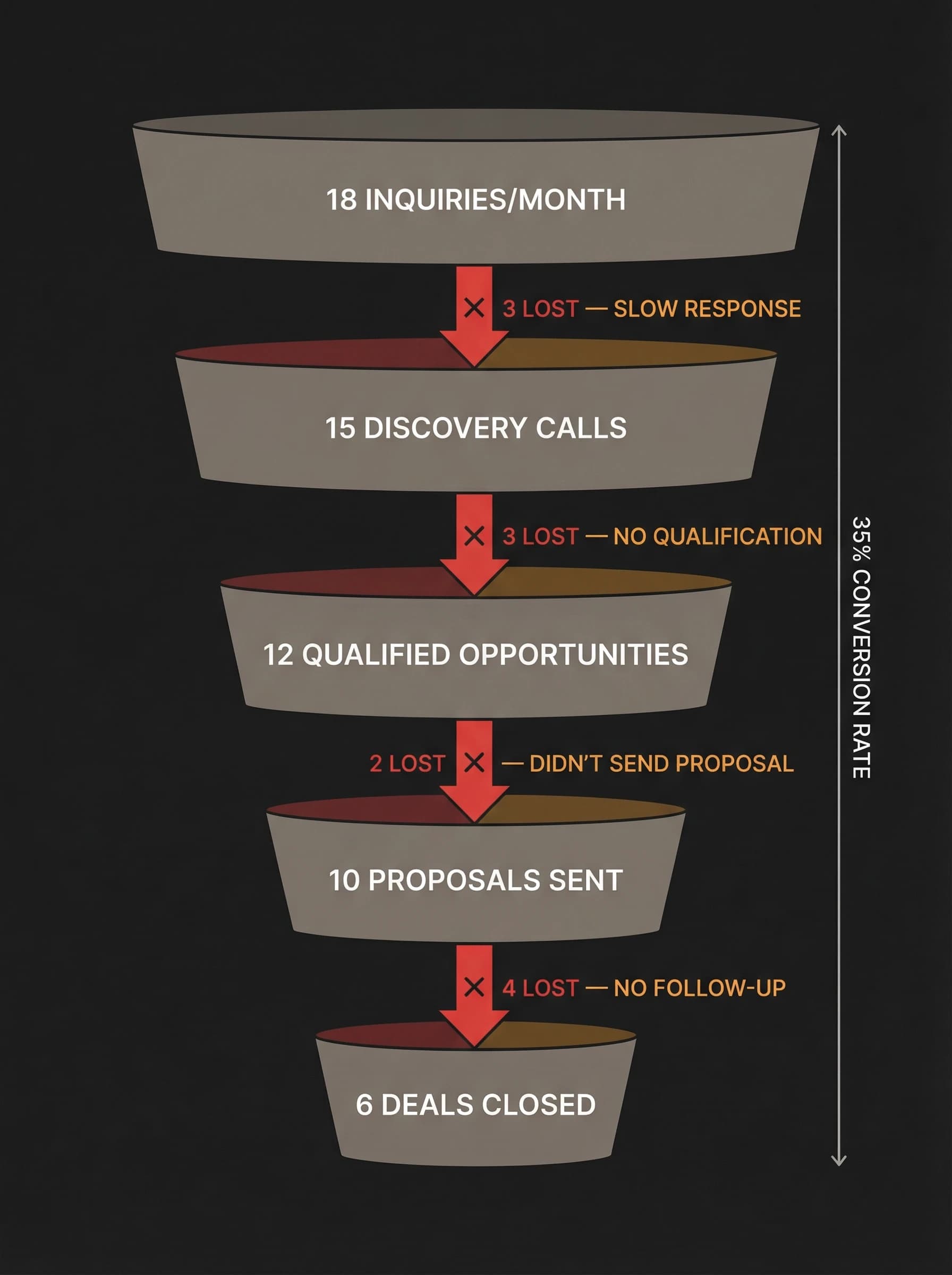
Inquiries came in through email, LinkedIn DMs, the website contact form, sometimes phone calls. Each founder managed their own inbox. There was no shared view of what was in the pipeline. Sometimes an inquiry would sit for three or four days before anyone responded.
Discovery calls ran anywhere from 30 minutes to two hours, depending on how the conversation went. No standard questions. No qualification criteria. They'd spend 90 minutes with someone who turned out to have a €2,000 budget for a project that should cost €15,000.
After the call, one of the founders would open InDesign and start building a proposal from scratch. Beautiful documents — 15 to 20 pages, custom designed for each prospect. Six to eight hours of work per proposal. Most of these proposals went nowhere.
Follow-up was essentially random. They'd send the proposal, then wait. Maybe send one email a week later if they remembered. Often they'd lose track entirely — a prospect who said "I need to think about it" would simply disappear into the void.
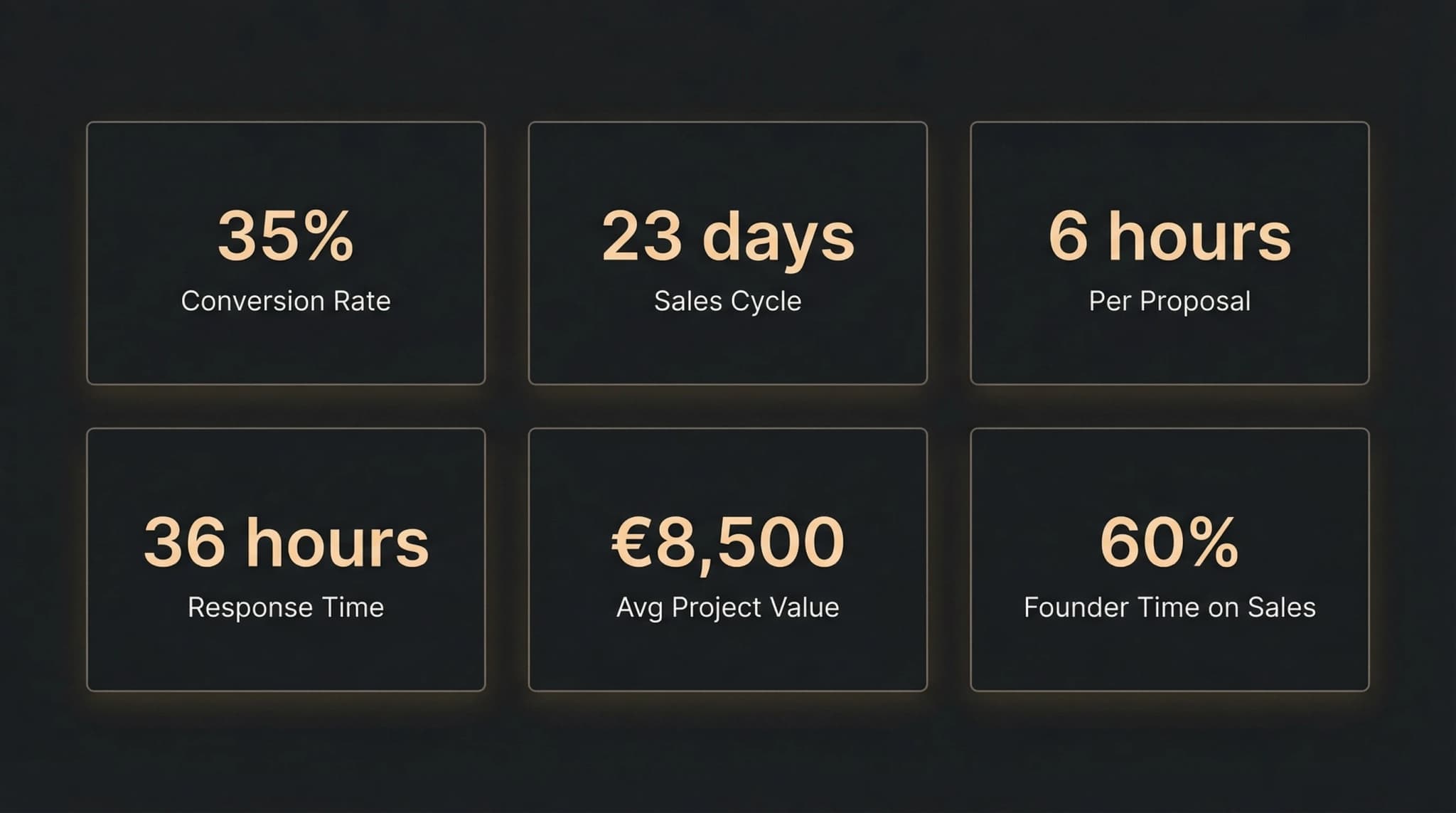
The numbers told the story: 18 inquiries per month, 6 deals closed. A 35% conversion rate that felt worse than it was because of all the time wasted on the 65% that didn't close.
Pricing Was a Guessing Game
Every project was priced individually. Same scope, different client, different price — depending on how the founder felt that day, what they thought the client could afford, how much they wanted the project.
I analyzed their last 40 projects. Logo designs ranged from €3,000 to €7,000. Brand identity projects ranged from €8,000 to €18,000. There was no logic to the variation. They were leaving money on the table on some projects and probably losing others by pricing too high.
The founders knew this was a problem but didn't know how to fix it. "Every project is different," they told me. "How can we standardize pricing for creative work?"
Proposals Were Beautiful and Wasteful
The proposals themselves were impressive — genuinely well-designed documents that showcased their capabilities. But they took six hours each to create, and the close rate on proposals was only 63%.
That meant they were spending roughly 24 hours a month creating proposals that went nowhere. Almost a full work week, every month, on documents that didn't convert.
And the proposals that did convert? Clients later told me they barely read them. They'd looked at the pricing page, maybe skimmed the timeline, and made a decision. The 15 pages of process explanation and case studies weren't driving the decision.
The Real Problem
These weren't just operational issues. They were identity issues.
Both founders had become designers because they loved design, not business. They viewed "sales" as something slightly distasteful — necessary, but beneath their creative capabilities. Words like "follow-up sequence" and "qualification framework" felt corporate and impersonal.
So they avoided anything that felt like selling. They sent proposals and hoped for the best. They didn't follow up because they didn't want to be "pushy." They priced inconsistently because having a clear price list felt too transactional.
The result was a commercial process that reflected their discomfort rather than their capabilities. And it was costing them money.
The Architecture
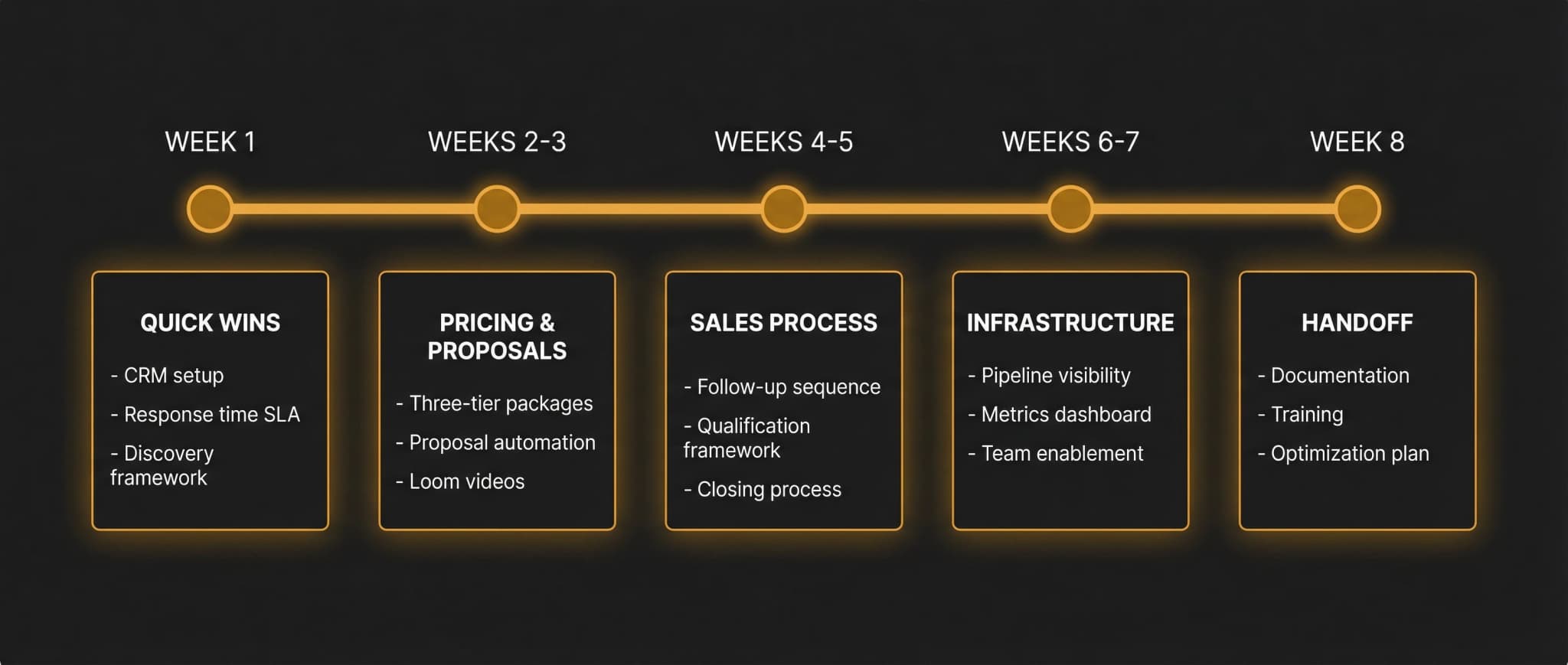
I had eight weeks. Not enough time to rebuild everything, so I focused on the changes that would have the biggest impact with the least disruption.
Week 1: Quick Wins
Before building anything sophisticated, I fixed the obvious problems.
Set up Pipedrive as a simple CRM. Every inquiry now went into one system that both founders could see. No more prospects falling through the cracks because they were stuck in someone's personal inbox.
New rule: every inquiry gets a response within four hours. Set up Slack alerts so new leads triggered an immediate notification. Created three email templates for common first responses.
Built a 10-question framework that covered qualification and scoping in 30 minutes. No more 90-minute calls that went nowhere. If someone wasn't qualified, they found out in the first 10 minutes, not the last 10.
By the end of week one, response time had dropped from 36 hours to 3 hours. Discovery calls went from 90 minutes to 30 minutes. Small changes, but they freed up time for everything else.
Weeks 2-3: Pricing Architecture
This was the hard part. The founders were genuinely afraid of standardized pricing. They thought it would make them seem "corporate" and limit their creativity.
I showed them their own data. The pricing variation wasn't strategic — it was random. Same deliverables, different prices, no clear logic. They weren't being flexible; they were being inconsistent. And inconsistency was costing them deals and leaving money on the table.
Created tiered packages.
For brand identity work, I designed three tiers:
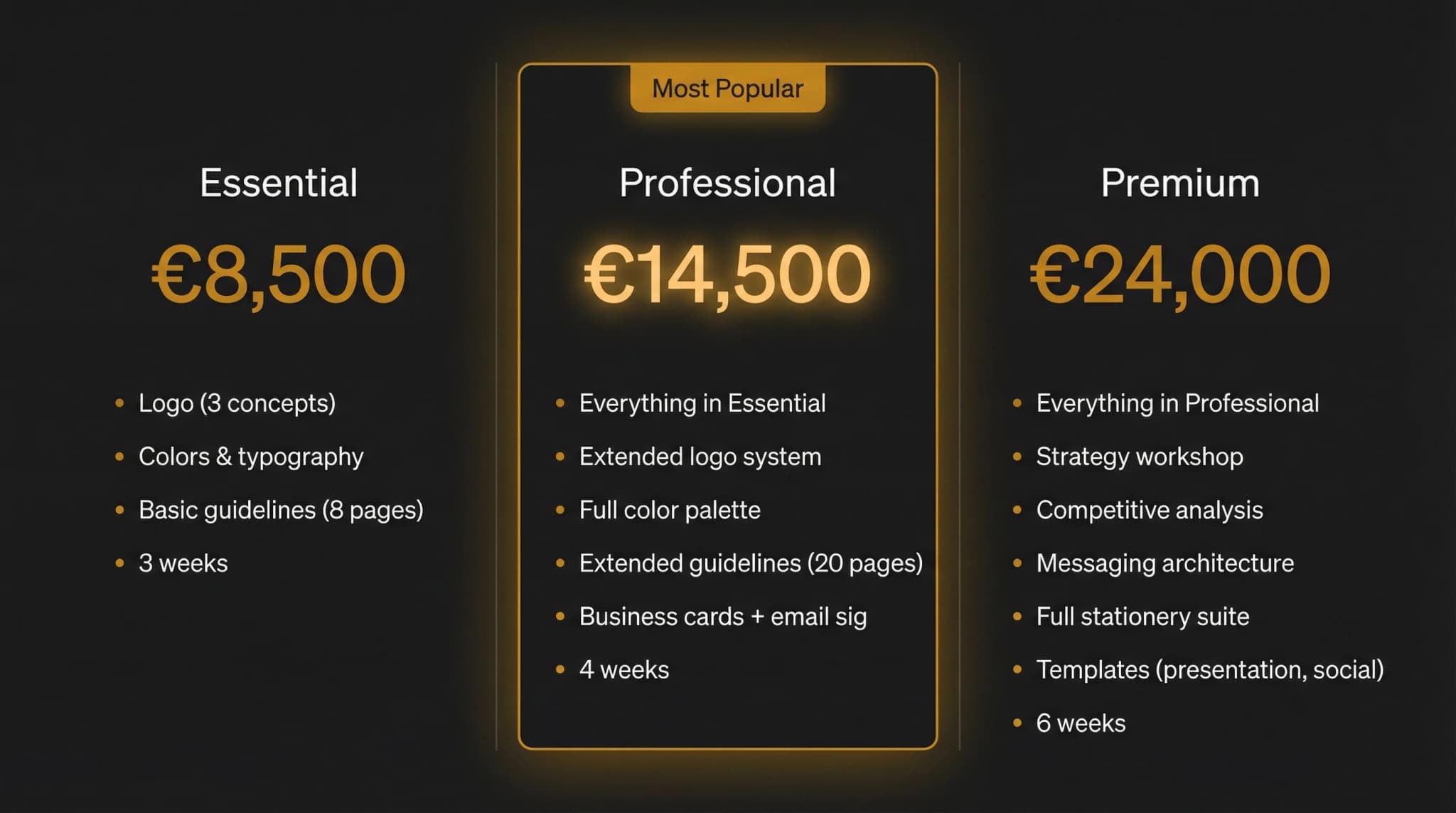
Essential — €8,500
- Logo design (3 concepts, 2 revision rounds)
- Color palette (primary and secondary)
- Typography selection (2 fonts)
- Basic brand guidelines (8 pages)
- Timeline: 3 weeks
Professional — €14,500
- Everything in Essential
- Extended logo system (variations, submarks, favicon)
- Comprehensive color palette (12+ colors)
- Typography hierarchy (headers, body, captions)
- Pattern and texture library
- Extended guidelines (20 pages)
- Business card and email signature design
- Timeline: 4 weeks
Premium — €24,000
- Everything in Professional
- Half-day brand strategy workshop
- Competitive analysis
- Messaging architecture
- Full stationery suite
- Presentation template
- Social media templates
- Comprehensive guidelines (40+ pages)
- Timeline: 6 weeks
The psychology mattered. Three tiers isn't arbitrary. The Premium tier anchors high, making Professional seem reasonable. Most clients land on Professional — it feels like the "right" choice, neither cheap nor excessive. Essential exists for price-sensitive clients who might otherwise walk away.
The founders worried clients would feel boxed in. The opposite happened. Clients appreciated the clarity. They could see exactly what they were getting at each level and make an informed choice. Several said the clear pricing was part of why they chose to work with the consultancy.
Weeks 2-3: Proposal Automation
The six-hour proposals had to go.
I built a proposal generator in Notion. Input the client name, industry, selected package, and any custom additions. The system outputs a complete proposal: cover page, project overview, scope of work, pricing, timeline, terms, and next steps.
The customization happens in two places: a personalized introduction paragraph (5 minutes to write) and selecting which case studies to include (2 minutes to choose from a library of 15).
Total time: 45 minutes instead of 6 hours.
But here's what made the real difference: Loom videos.
Instead of sending a PDF and hoping the client reads it, the founders now record a 3-5 minute video walking through the proposal. They share their screen, explain the key points, address obvious questions, and end with a clear next step.
Clients loved this. Multiple people mentioned it in feedback — "the video walkthrough was really helpful," "felt more personal than just getting a document." It differentiated the consultancy from competitors who just emailed PDFs into the void.
Weeks 4-5: The Follow-Up System
This was where the biggest gains came from.
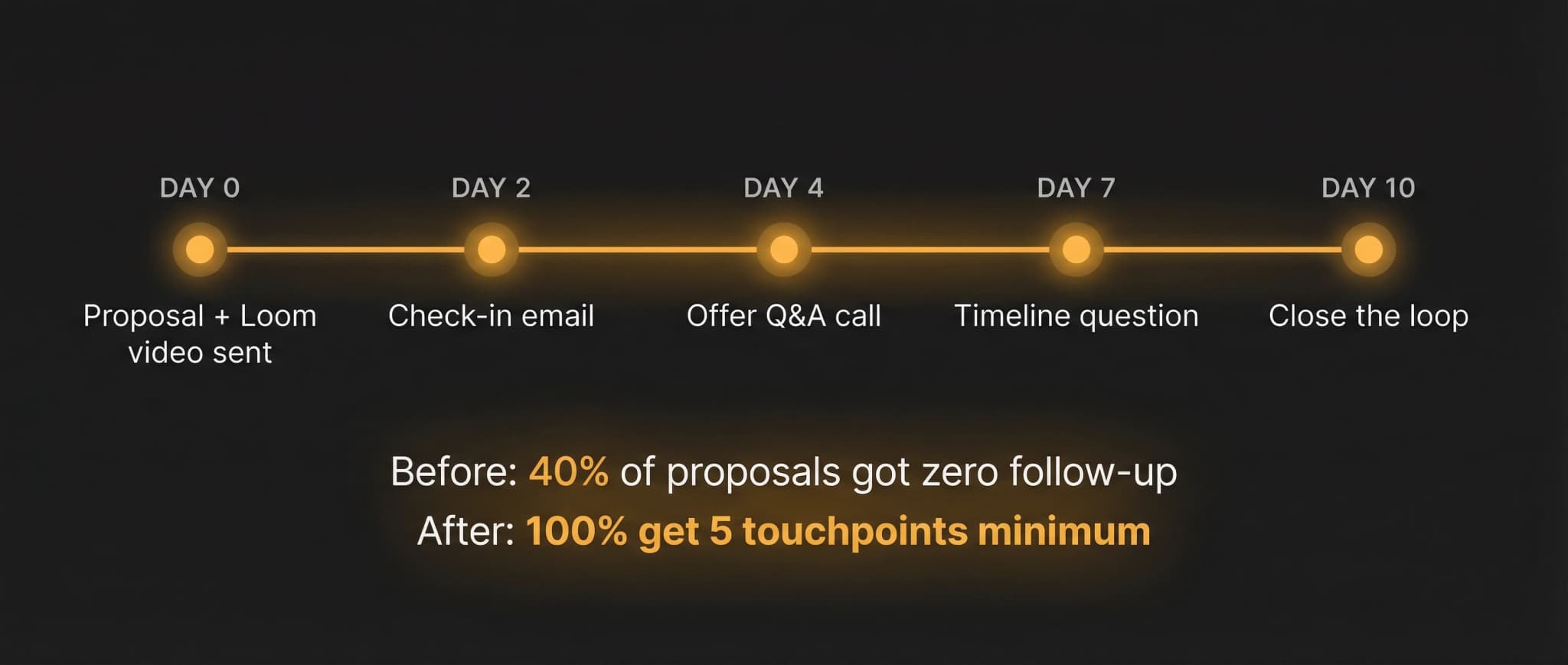
Before, follow-up was random. Send a proposal, wait, maybe send one email a week later, lose track. About 40% of proposals got no follow-up at all.
I built a systematic sequence:
- Day 0: Proposal sent with Loom video
- Day 2: Quick check-in — "Did you get a chance to look at this?"
- Day 4: Offer a call — "Any questions? Happy to walk through anything."
- Day 7: Timeline check — "What's your decision timeline looking like?"
- Day 10: Close the loop — "Should I keep this opportunity open or close it out?"
The founders initially resisted. "We don't want to be pushy." I reframed it: following up isn't pushy, it's helpful. The prospect asked for a proposal. They want to make a decision. You're helping them move forward, not bothering them.
The Day 10 email was particularly effective. Giving someone explicit permission to say no actually made them more likely to say yes — or at least to respond honestly about their timeline.
Many deals closed on the third or fourth follow-up. Before, those deals would have been lost to silence.
Weeks 4-5: Qualification Framework
Not every inquiry deserves a proposal. But the founders were treating every inquiry the same — spending hours on prospects who were never going to close.
I built a simple qualification framework:
- Budget: Can they afford at least €8,500? (If not, refer to junior designer network.)
- Timeline: Do they need this in less than 2 weeks? (Red flag — usually means they're not serious.)
- Authority: Is the person on the call the decision-maker? (If not, get the decision-maker on a call.)
- Need: Do they actually need brand design, or something else? (Sometimes they need marketing strategy, not a logo.)
- Design maturity: Do they understand the value of professional design? (Scale of 0-3. Below 2 means they'll fight every invoice.)
If a prospect failed on budget or timeline, no proposal. Polite decline with a referral to someone more appropriate. This felt harsh at first, but it freed up time for qualified opportunities.
Weeks 6-7: Pipeline Visibility
With the process working, I built the infrastructure to track it.
Pipedrive pipeline stages:
- New Inquiry
- Discovery Scheduled
- Discovery Completed
- Proposal Sent
- Follow-Up in Progress
- Closing Discussion
- Won / Lost
Automation via Make.com:
- New inquiry to Slack alert to Pipedrive entry
- Discovery scheduled to Calendar block + reminder emails
- Proposal sent to Follow-up sequence triggered
- Day 10 with no response to Auto-move to Lost
Weekly dashboard in Notion tracking:
- Leads received
- Response time average
- Discovery calls completed
- Proposals sent
- Conversion rates (inquiry to proposal, proposal to close)
- Average project value
- Sales cycle length
The founders could now see exactly what was happening. No more guessing about pipeline health or wondering where deals stood.
Week 8: Documentation and Handoff
Everything got documented:
- 18-page sales playbook covering the complete process
- 8-page pricing guide with all packages and positioning
- 12-page operations manual for CRM and automation
- Template library for every email scenario
Three training sessions with the founders and their project manager, who would handle most of the administrative work going forward.
The Execution
The implementation was intensive but focused. We didn't try to change everything — just the things that would have the biggest impact on conversion and efficiency.
The hardest part wasn't the systems. It was the mindset shift.
Getting the founders to follow up systematically took practice. The first few times, they felt awkward sending the Day 4 and Day 7 emails. But when deals started closing that would have previously gone dark, they became converts.
Recording Loom videos felt strange at first too. "Do people really want to watch me talk through a PDF?" They did. Client feedback was consistently positive.
By mid-October, the new process felt natural. The founders spent their mornings on discovery calls and proposals (now taking a fraction of the time), and their afternoons on actual design work.
The Transformation
The Numbers
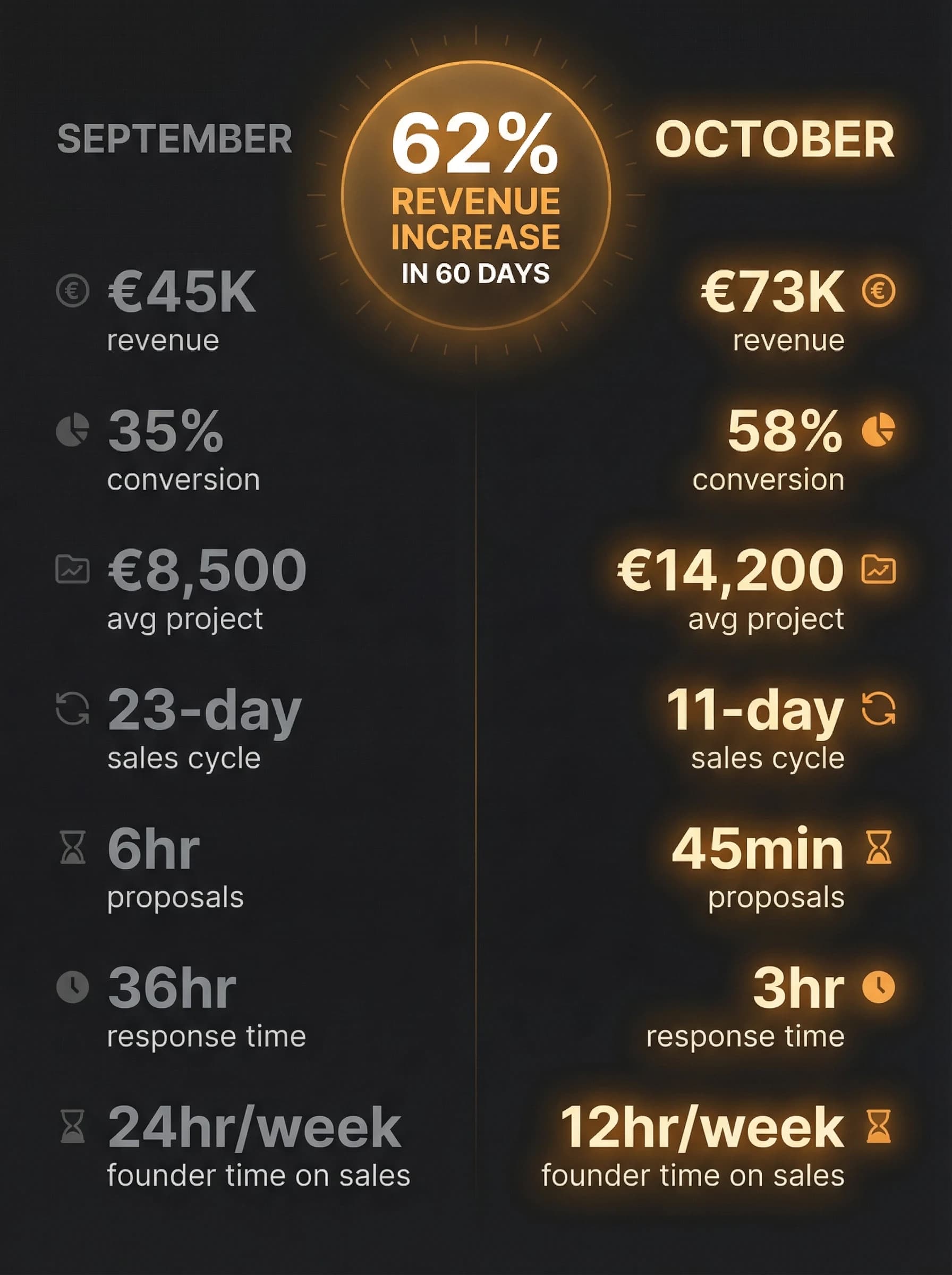
| Metric | September 2024 | October 2024 | Change |
|---|---|---|---|
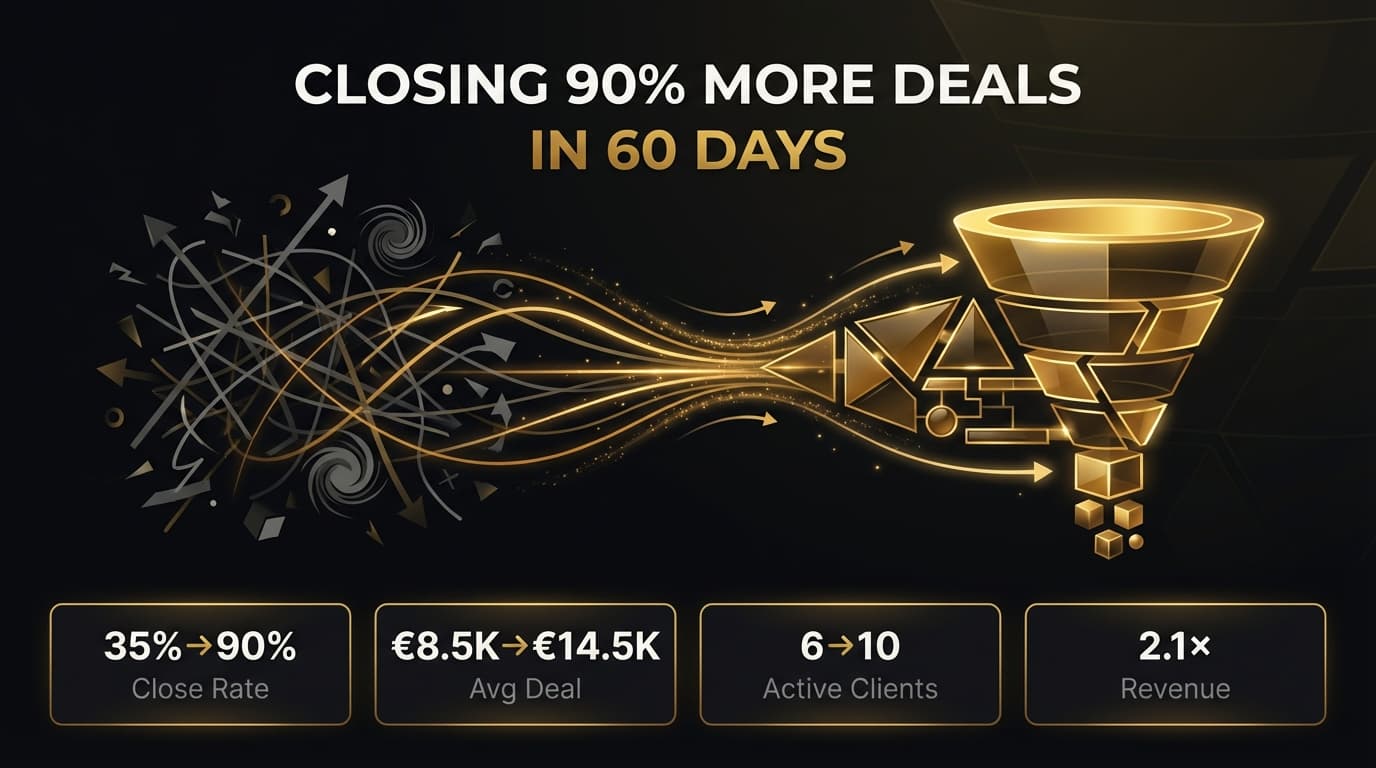
| Monthly Revenue | €45,000 | €73,000 | +62% |
| Leads Received | 18 | 21 | +17% |
| Discovery Calls | 12 | 17 | +42% |
| Proposals Sent | 10 | 14 | +40% |
| Deals Closed | 6 | 12 | +100% |
| Conversion Rate | 35% | 58% | +66% |
| Average Project Value | €8,500 | €14,200 | +67% |
| Sales Cycle | 23 days | 11 days | -52% |
| Proposal Creation Time | 6 hours | 45 minutes | -87% |
| First Response Time | 36 hours | 3 hours | -92% |
| Founder Time on Sales | 24 hrs/week | 12 hrs/week | -50% |
Where the Packages Landed
The tiered pricing worked exactly as designed:
- Essential (€8,500): 25% of projects — price-sensitive clients who would have walked away otherwise
- Professional (€14,500): 58% of projects — the sweet spot, most clients landed here naturally
- Premium (€24,000): 17% of projects — clients who wanted the full strategic engagement
Average project value jumped from €8,500 to €14,200. Not because the work changed, but because the packaging made clients more likely to choose the middle tier instead of negotiating down to the minimum.
What Actually Changed
The founders went from dreading sales to treating it like any other design problem — something to be solved systematically.
Before, they avoided follow-up because it felt "pushy." Now they had a system that gave them permission to follow up. The awkwardness disappeared because the process was documented. They weren't making judgment calls about whether to send another email; they were just following the sequence.
Before, they spent 24 hours a week on sales activities and still lost deals. Now they spent 12 hours a week and closed twice as many. The time savings went directly into creative work — the thing they actually wanted to be doing.
The project manager took over most of the CRM administration and follow-up tracking. The founders just showed up for discovery calls and closing conversations.
Six Months Later
I checked in with them in April 2025.
Monthly revenue had stabilized between €95,000 and €105,000. They'd added two designers to the team. They were considering a second office.
The systems stuck. They'd updated the pricing (raised everything by 15%), added a fourth "Enterprise" tier for larger clients, and built a referral program that I hadn't gotten to during my engagement.
The Loom videos became a signature. Competitors started copying them, which the founders took as validation.
Most importantly, they were designing again. The whole point of starting the consultancy — doing interesting creative work for interesting clients — was finally possible because they weren't drowning in commercial chaos.
What This Case Teaches
Packaging isn't the enemy of creativity
The founders' biggest fear was that standardized pricing would make them seem corporate and limit their creative flexibility. The opposite happened. Clear packages made conversations easier, clients more confident, and prices higher. The creativity happened in the work, not in the pricing negotiation.
Follow-up is where deals are won
The systematic follow-up sequence was probably the single highest-impact change. Before, 40% of proposals got no follow-up. After, 100% got five touchpoints. Many deals closed on the third or fourth contact — deals that would have been lost to silence under the old approach.
Time saved only matters if you reinvest it
Cutting proposal time from 6 hours to 45 minutes freed up 15+ hours per week. But that only translated to revenue because the founders put those hours into more discovery calls and creative work. Efficiency gains need to be deliberately redeployed.
Small personal touches differentiate
The Loom videos cost nothing to implement and took 5 minutes each. But clients mentioned them repeatedly. In a market where most competitors send PDFs and hope for the best, a short personal video stands out. Sometimes the smallest changes have the biggest impact on perception.
Constraints force focus
Eight weeks wasn't much time. But the constraint was helpful. It forced me to identify the 20% of changes that would drive 80% of results. With more time, I might have built elaborate systems that weren't necessary. The time pressure kept us focused on what actually mattered.
We used to think 'sales process' meant becoming the kind of agency we left. Corporate, impersonal, pushy. Turns out it just means being organized. The packages give us a structure for conversations. The follow-up sequence means we don't lose deals by forgetting about them. And I'm actually designing again, which is why I started this company in the first place.— Co-Founder, Design Consultancy
Recognize This Pattern?
Founder dependency. Sales bottlenecks. Operations that can't keep pace with ambition. These aren't character flaws — they're architecture problems. And architecture can be designed.
If you're generating €1M+ annually but growth creates chaos instead of freedom, we should talk.
Get insights like this in your inbox
One email per week — brand, content, and growth architecture insights.