Brand Debt Is Silently Killing Your Margins — And Your Next Rebrand Won't Fix It
Borrows the 'technical debt' concept from software engineering to expose how years of ad-hoc brand decisions compound into a hidden operational cost that erodes margins, slows sales cycles, and makes every marketing euro work harder than it should
- ◆Brand debt accumulates silently through inconsistent assets, outdated materials, and decentralized decisions that erode margin over time.
- ◆A rebrand treats symptoms rather than root causes — without systemic governance, new assets generate new debt immediately.
- ◆The real cost of brand debt is measured in sales cycle friction, discount pressure, and customer trust, not design budgets.
- ◆Consistent brand execution is an operational discipline, not a creative one — it requires process and accountability, not just better guidelines.
- ◆Companies that audit and retire conflicting brand assets before rebranding see faster ROI and longer-lasting brand coherence.
Every company I audit has a drawer — sometimes literal, sometimes a shared drive folder named "OLD - DO NOT USE" — filled with brand assets that contradict each other. Three logo variants nobody approved. A sales deck from 2021 still in active rotation because "it just works." Campaign visuals built in Canva by a regional manager who needed something by Friday. None of these decisions were malicious. All of them were rational in the moment. And together, they are silently compounding into a structural liability that is eroding your margins right now.
In software engineering, this phenomenon has a precise name: technical debt — the accumulated cost of shortcuts taken during development that must eventually be paid back with interest. Your brand has the same problem. We call it brand debt, and it may be the most expensive line item that never appears on your P&L.
What Brand Debt Actually Is
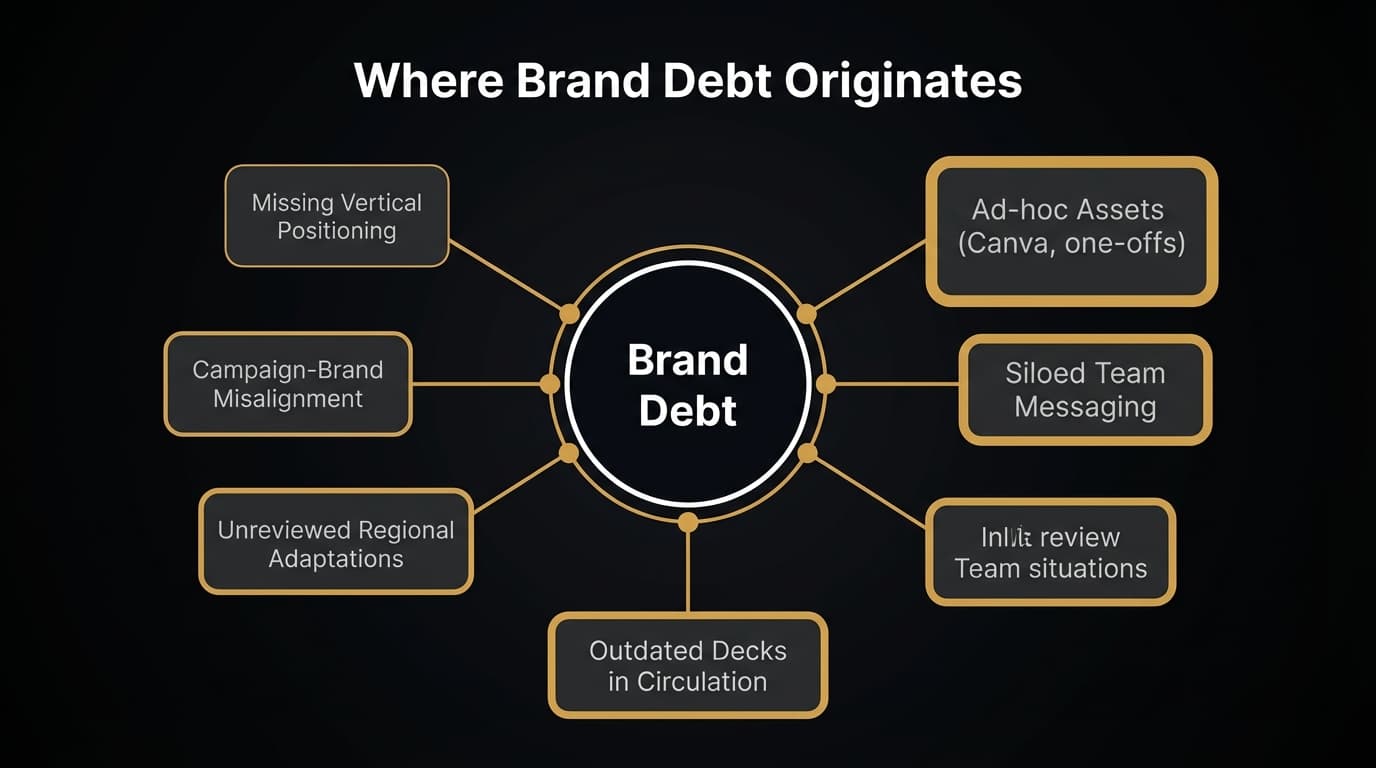
Brand debt is not "bad branding." It is the compounding operational cost of every ad-hoc brand decision made without a governing system. Every time a team member creates a one-off asset, improvises positioning in a pitch, or launches a campaign that contradicts previous messaging — that is a deposit into your brand debt account. And like financial debt, it accrues interest.
The individual decisions feel harmless:
- The sales team builds their own pitch deck because the official one does not address their vertical
- A regional office tweaks the logo to "modernize" it for a local campaign
- Marketing launches a brand campaign with a visual direction that the product team has never seen
- Customer success uses messaging that directly contradicts what sales promised
Each shortcut saves time today. Each one costs exponentially more tomorrow. This is not a creative problem. It is an operational one — and treating it as anything less is why most companies reach for the wrong solution.
The Compounding Mechanics: How Brand Debt Accelerates
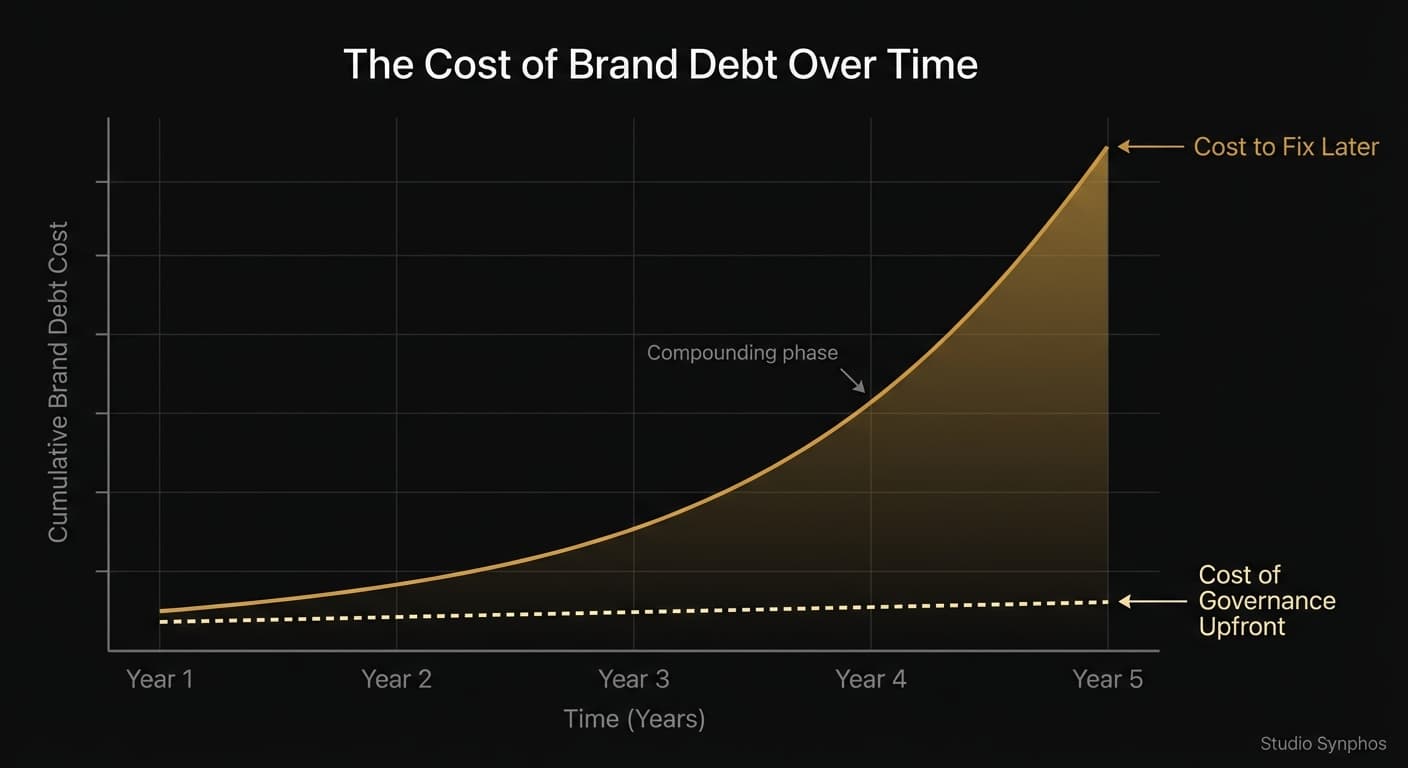
What makes brand debt dangerous is the same thing that makes financial debt dangerous: compounding. A single inconsistent asset is noise. A hundred of them, accumulated over three years across five departments, is a structural failure.
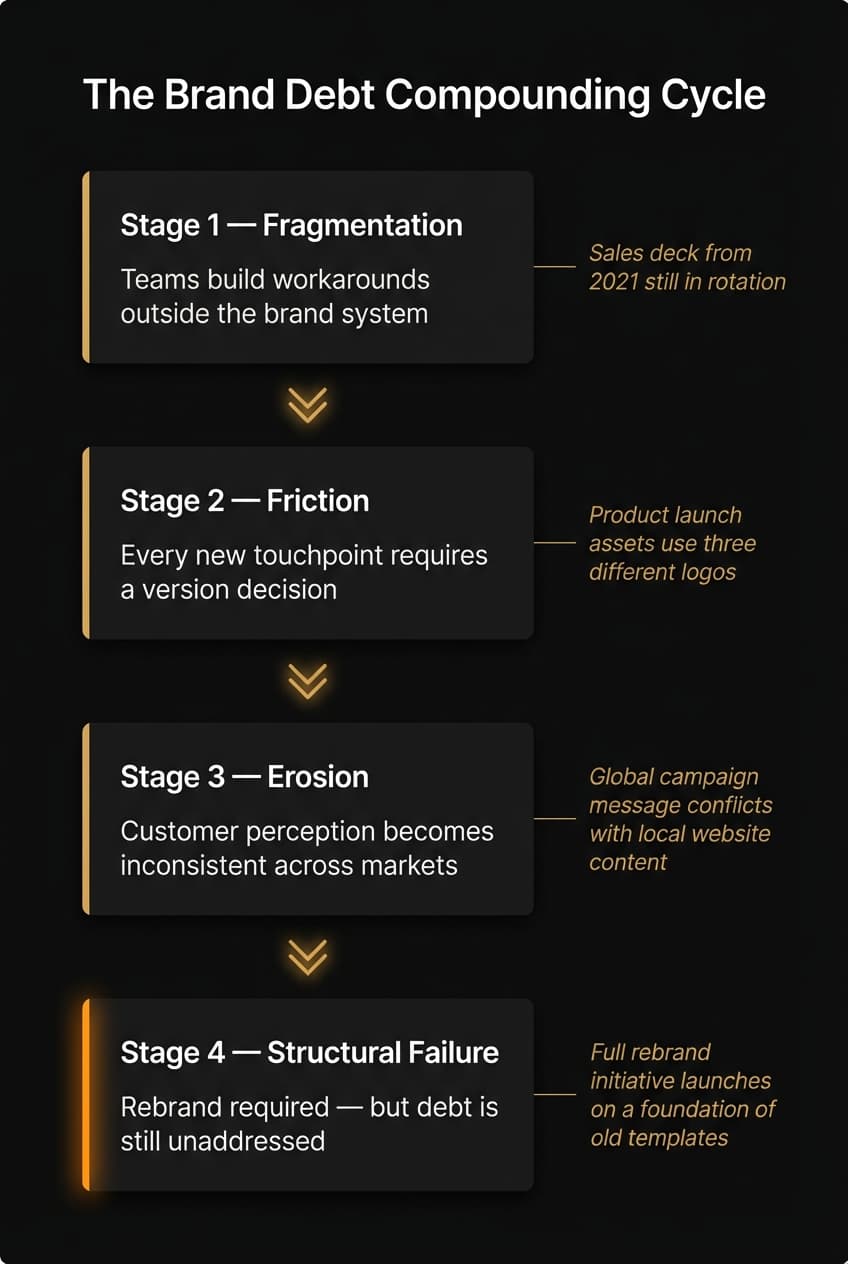
Here is how the compounding works in practice:
Stage 1: Fragmentation
Individual teams create workarounds because the brand system — if one exists at all — does not serve their actual use cases. The sales team needs vertical-specific positioning. The recruitment team needs employer brand materials. The partnerships team needs co-branded templates. None of these existed in the original brand guidelines PDF that an agency delivered eighteen months ago, so everyone improvises.
Stage 2: Friction
With multiple versions of the brand in circulation, every new touchpoint requires a decision: which version is correct? Approval cycles slow down. Creative teams spend more time debating what is "on brand" than producing work. New hires cannot tell the difference between current and deprecated assets. The cost shows up as longer production timelines and ballooning creative budgets — but nobody traces it back to the root cause.
Stage 3: Erosion
The market starts receiving contradictory signals. Your website says one thing, your LinkedIn says another, and your sales team says a third. Prospects take longer to convert because they are subconsciously processing the inconsistency. Research backs this up: companies with consistent brand presentation see revenue increases of up to 33%, which means the inverse is also true — inconsistency is leaving significant revenue on the table.
Stage 4: The Rework Tax
This is where the real margin destruction happens. Fragmented marketing operations lead to a 20% increase in media buying costs with no corresponding performance gain. Every campaign must re-establish positioning from scratch because nothing builds on what came before. Content cannot be repurposed because messaging varies across assets. I have seen companies where 15-25% of the marketing budget is effectively spent on rework — recreating assets, realigning messaging, resolving internal debates about "what we actually stand for."
52% of senior professionals at mid-to-large businesses report that poor brand consistency costs their companies over $6 million annually in lost revenue. For 28% of companies, that figure exceeds $10 million per year. These are not branding costs. These are operational costs disguised as branding costs.
Why Your Next Rebrand Will Not Fix This
When margins erode and the brand feels "stale," the instinct is to rebrand. New logo, new colors, new agency, new energy. It feels like a fresh start. It is not. It is repainting a house with a cracked foundation.
The data is unambiguous. 80% of rebrand failures stem from incorrect motivations — cosmetic ambition rather than structural diagnosis. The cautionary tales are well-documented:
| Company | Investment | Result | Time to Failure |
|---|---|---|---|
| Tropicana (2009) | $35M rebrand | 20% sales drop, ~$30M in losses | 2 months |
| Gap (2010) | New logo rollout | Abandoned after public backlash, $100M cost | 6 days |
| Twitter → X (2023) | Full corporate rebrand | Lost cultural significance and brand equity | Ongoing |
These are not design failures. Tropicana's new packaging was perfectly competent graphic design. Gap's logo was inoffensive. The failures were architectural — the expression layer was changed without addressing (or even diagnosing) the structural layer beneath it.
A rebrand gives you new assets. It does not give you:
- Decision rules for how those assets should be used across contexts
- Governance for who can create, modify, or extend brand materials
- Scalability so the system serves new markets, products, or teams without improvisation
- Measurement to know whether the brand is being deployed consistently
Without these, you will accumulate exactly the same brand debt with your new brand that you accumulated with your old one — just with a more expensive logo.
The Audit: Diagnosing Your Brand Debt
Before you can retire brand debt, you need to quantify it. Here is the diagnostic framework we use at Studio Synphos during our discovery process:
1. Asset Inventory
Catalogue every brand-related asset currently in use across the organization — not what is in the brand guidelines, but what people actually use day to day.
- How many logo variants exist in the wild?
- How many presentation templates are in active rotation?
- How many different taglines, value propositions, or positioning statements appear across touchpoints?
In most companies we audit, the number of "unofficial" assets outnumbers official ones by a factor of three to five.
2. Decision Archaeology
Map the last 20 brand-related decisions made across the company. For each one, ask:
- Was there a documented rule that guided this decision?
- Was there an approval process?
- Did the person making the decision have access to current brand assets?
- Did the existing brand system actually serve their use case?
This reveals whether brand debt is a discipline problem (people ignoring the system) or a design problem (the system does not serve its users). In our experience, it is almost always the latter.
3. Rework Quantification
Track how much time and budget is spent on:
- Recreating assets that should already exist
- Approval cycles caused by ambiguity about what is "on brand"
- Campaign production delays caused by missing or conflicting guidelines
- Internal debates about messaging, positioning, or visual direction
Assign a euro value. This is your brand debt's cost of carry — the annual tax you pay for not having a functioning brand operating system.
4. Revenue Impact Mapping
Examine your sales cycle and customer journey for friction caused by brand inconsistency:
- Are sales reps improvising positioning? Measure close rate variance across reps
- Does onboarding messaging match sales messaging? Survey new customers
- Are campaigns building on each other or starting from zero? Analyze campaign-level CAC trends
The Architectural Solution: Brand as Operating System
The opposite of brand debt is not "a great brand." It is brand architecture — a structural system that makes consistent brand expression the path of least resistance for everyone in the organization.
At Studio Synphos, we distinguish between three layers that most agencies collapse into one:
| Layer | What It Contains | What It Solves |
|---|---|---|
| Brand Expression | Logo, colors, typography, imagery | "What do we look like?" |
| Brand Architecture | Decision rules, governance, scalability frameworks | "How do we stay consistent as we grow?" |
| Brand Operations | Templates, workflows, approval systems, measurement | "How does this work day to day across teams?" |
A rebrand addresses the first layer. A brand identity system addresses the first two. A brand operating system addresses all three — and it is the only approach that actually retires brand debt rather than refinancing it.
What a Brand Operating System Looks Like in Practice
When we built the brand system for BestWax Center, a premium waxing salon franchise expanding across Budapest, the challenge was not creating beautiful brand assets — they already had those. The challenge was building a system that could scale across locations without the founder personally approving every piece of content.
The brand operating system we architected included decision rules for how cosmeticians could represent the brand on social media, content principles that governed what was on-brand without requiring case-by-case approval, and templates that served actual use cases rather than theoretical ones. The result: from near-zero online presence to 11,000+ followers and 300,000 average monthly views — but more importantly, a new salon location went from zero to 140 clients per month within three months of opening, because the brand system did the pre-selling work that would otherwise require individual relationship building at scale.
That is the difference between brand expression and brand architecture. Expression makes you look good. Architecture makes your growth cheaper.
We see the same pattern across every engagement. When we architected the revenue system for a wood industry B2B client, the integrated brand and pipeline architecture led to 90% more deals closed — not because the brand "looked better," but because consistent positioning across touchpoints eliminated the friction that was extending sales cycles. When we built the growth system for a healthcare coaching company, the founder went from handling 100% of sales personally to less than 5%, while the team scaled from 5 to 25 people and revenue grew 7.8× in ten months. That kind of operational leverage is impossible when every team member is improvising the brand.
The Real ROI of Retiring Brand Debt
The return on brand architecture is not "better brand perception." It is measurable operational efficiency:
- Reduced rework: When assets serve actual use cases and decision rules are clear, teams stop reinventing the wheel. The 15-25% of marketing budget consumed by rework gets redirected to growth
- Faster sales cycles: When positioning is consistent across touchpoints, prospects arrive pre-educated. They spend less time evaluating and more time deciding
- Lower customer acquisition costs: When campaigns build on each other instead of starting from zero, media buying efficiency improves and CAC trends downward
- Scalable growth: When the brand system works without the founder in the room — across new locations, new markets, new team members — growth does not require proportional increases in brand management overhead
- Compounding equity: Every touchpoint reinforces the same positioning, and brand equity accumulates instead of dissipating. This is the opposite of brand debt — it is brand compound interest
The companies that understand this treat brand architecture the way engineering teams treat infrastructure: as an investment that pays dividends on every subsequent project. The companies that do not will keep rebranding every three to five years, each time wondering why the results do not last.
Brand debt is not a creative problem. It is a systems problem. And systems problems require systems solutions — not a new coat of paint.
If you want to understand where your brand debt is accumulating and what retiring it would be worth, that conversation starts here.
Brand Debt Calculator
How much brand debt is silently eroding your margins? Rate each indicator (0 = severe debt, 100 = no debt)
How consistently is your logo, color palette, and typography used across all materials?
Can every team member articulate your value proposition the same way?
Do documented, up-to-date brand guidelines exist and are they actually followed?
Does every customer touchpoint (website, email, pitch deck, social) feel like the same brand?
Are your products, services, and sub-brands clearly structured and logically named?
Does the market perceive you the way you intend? Is there a gap between identity and image?
Your brand is actively costing you money. Every inconsistency erodes margins.
Fix these first
Audit every customer-facing asset. Count the variations. Each one is compounding debt.
Record how 5 team members describe the company. If they differ, your messaging leaks revenue.
Frequently Asked Questions
What is the difference between brand debt and just having an outdated brand?
An outdated brand is an expression problem — the visuals or messaging no longer reflect who you are. Brand debt is a structural problem — the accumulation of inconsistent decisions, workaround assets, and missing governance that creates operational drag regardless of how current your brand looks. You can have a brand that was redesigned last year and still carry massive brand debt if the redesign did not include decision rules, templates for real use cases, and governance for how teams deploy the brand day to day.
How do I know if my company has significant brand debt?
Three diagnostic questions: First, how many "unofficial" brand assets (presentations, social graphics, one-pagers) exist outside your official brand guidelines? If the answer is "I have no idea," you have significant debt. Second, when a new team member needs to create a client-facing asset, can they do it without asking someone what is "on brand"? If not, your system is not self-serving. Third, do your campaigns build on each other, or does each one establish positioning from scratch? If it is the latter, your brand debt is actively inflating your customer acquisition costs.
Is brand debt only a problem for large companies?
No — it is actually more dangerous for mid-size companies (€1-20M revenue) because they have enough teams and touchpoints for inconsistency to compound, but not enough resources to absorb the inefficiency. A five-person startup can align around a shared understanding of the brand. A fifty-person company with sales, marketing, customer success, and partnerships teams cannot — not without a system. The inflection point where brand debt starts visibly eroding margins is usually around 20-30 employees or when expanding into new markets or segments.
How long does it take to retire brand debt?
The diagnosis phase — auditing assets, mapping decisions, quantifying rework — typically takes two to four weeks. Building the brand operating system (architecture, decision rules, governance, templates) takes six to twelve weeks depending on complexity. But the important distinction is that you are not "fixing the brand" — you are building infrastructure. Like any infrastructure investment, it starts paying returns immediately and compounds over time. Most clients see measurable reduction in production timelines and approval cycles within the first month of deployment.
Can we retire brand debt without doing a full rebrand?
Yes — and in most cases, you should. A rebrand is expensive, disruptive, and often unnecessary. What most companies actually need is not new brand expression but brand architecture layered on top of their existing identity: decision rules, governance, scalable templates, and operational workflows. We frequently work with companies whose visual brand is perfectly sound but whose brand operations are generating enormous hidden costs. Retiring brand debt is about building the system, not changing the surface.
Get insights like this in your inbox
One email per week — brand, content, and growth architecture insights.
Related Articles
The Brand Perception Paradox
Up to 75% of brand building comes from experiential touchpoints — not controlled media. 88% of consumers say experience is as important as products. Yet companies obsess over logos, websites, and ads while ignoring what actually shapes perception: employee behavior, customer experience, and word of mouth.
Your Brand Has an Internal Customer Problem
86% of candidates trust employee recommendations over corporate advertising. 73% of people say experience drives buying decisions, but only 49% believe brands deliver. The biggest brand gap isn't between you and your customers — it's between your marketing department and your employees.
The Anatomy of Brands That Feel 'Effortless' — They're Actually Deeply Engineered
Apple's 'simple' iMac shell cost 3x a normal computer case. Muji governs 7,000+ SKUs with 3 design principles. Aesop custom-designs 70% of its stores in-house. The brands that feel effortless are the most deeply engineered systems in their industries.